
A Complete Guide to the Hong Kong DELE Spanish Exam: 2026 Registration, Preparation Tips, and Costs (Lazy Person's Summary)
Looking to obtain an internationally recognized Spanish language certificate in Hong Kong? The DELE Spanish Certificate (Diplomas de Español como Lengua Extranjera) is the perfect choice. Issued by the Cervantes Institute, an official Spanish institution, this certificate is valid worldwide and for life , making it a highly valuable asset for applications to overseas universities, multinational corporations, and even immigration.
Key points of this article
DELE's core value : The certificate is valid for life and serves as strong proof for applications to overseas universities and multinational corporations.
Hong Kong registration process : The only official test center is CityU SCOPE, which mainly holds exams in May and November each year. It is recommended to register 3-4 months in advance.
Exam structure : It is divided into two groups: "Reading + Writing" and "Listening + Speaking". Both groups must be passed to pass. You cannot specialize in one subject.
Test preparation strategy : It is recommended to allocate at least 3-6 months, initially to consolidate grammar and vocabulary, and later to focus on practicing mock test questions.
Professional guidance : The Hong Kong Spanish Cultural Association provides small-group teaching by native speakers, offering targeted training specifically for DELE candidates.
Who is this article suitable for?
Students planning to study in Spain or Latin America need proof of their official language proficiency.
For working professionals : They hope to stand out in the job market and increase their career competitiveness.
Spanish literature learner : wants to set a clear, quantifiable goal for their learning outcomes.
Want to know which DELE level of Spanish you're best suited for? WhatsApp us now to schedule a free level assessment and let our professional teachers tailor the most effective preparation path for you!
What is a DELE certificate? Why is the explanation so important to Hong Kong candidates?
In short, DELE is the world's most authoritative Spanish language proficiency test, designed specifically for non-Spanish speakers. It comprehensively assesses your overall abilities in listening, speaking, reading, and writing, and the certificate is widely recognized by universities, businesses, and government agencies worldwide.
For students and working professionals in Hong Kong, the value of a DELE certificate goes far beyond just a language proficiency certificate. You can think of it as a highly lucrative strategic investment that paves the way for your further education and career development, opening up more possibilities.
DELE's core value
Permanent validity : Unlike the SIELE exam, which is valid for two years, the DELE certificate is valid for life once it is obtained. Once you work hard, you will benefit for a lifetime, and you don’t have to worry about your qualifications expiring.
Academic stepping stone : If you hold a DELE B2 or higher certificate, you will have a significant advantage when applying to universities in Spain and Latin America. Some universities even list it as a prerequisite for admission.
A career passport : In the job market, the DELE certificate is the best objective proof of your language proficiency. Looking for positions in international trade, finance, tourism, or other related industries? Having it will definitely make you stand out.
According to the Cervantes Institute, DELE is designed in strict accordance with the Common European Framework of Reference for Languages (CEFR) to ensure that its assessment results are internationally consistent and reliable.
Corresponding to the six levels of CEFR
To help you plan your learning path more clearly, the DELE exam is divided into six levels, from basic to advanced, fully corresponding to the internationally recognized CEFR standards. You can choose the most suitable level based on your actual ability and goals. For more detailed information about the DELE exam , please refer to our page.
The table below clearly shows the required skills for each level, helping you quickly pinpoint your starting point.
DELE Exam Levels and CEFR Competency Levels (Simplified Table)
DELE level | CEFR corresponding level | Summary of Ability Description |
|---|---|---|
A1 | Beginner Level (Breakthrough) | They can understand and use basic phrases familiar in daily life to conduct simple self-introductions and Q&A sessions. |
A2 | Basic level (Waystage) | Can understand common phrases related to personal matters, family, shopping, and work. |
B1 | Intermediate (Threshold) | It can understand the main content of clear and standard speech in work, study, and leisure settings, and can handle most situations during travel. |
B2 | Vantage (Mid-to-High Level) | They can understand the main points of complex articles and communicate fluently and naturally with native speakers with almost no difficulty. |
C1 | Advanced (Effective Operational Proficiency) | They can understand various types of long articles with implicit meanings and express themselves fluently and naturally without having to deliberately search for words. |
C2 | Mastery | They can understand almost everything they hear or read effortlessly, express themselves accurately and fluently, and distinguish subtle semantic differences. |
From A1, the level of everyday communication, to C2, the level of proficiency, DELE offers a clear progression path. Whether your goal is to be able to order food while traveling in Spain or to give a speech at an international conference, there's a level for you.
Complete the Hong Kong DELE exam registration step by step
Want to take the DELE exam in Hong Kong? The whole process is actually much more straightforward than you think. The key is to grasp a few key moments and prepare the documents in advance, and you can easily get it done.
In Hong Kong, there is only one officially designated DELE test center: CityU SCOPE, the School of Professional and Continuing Education at City University of Hong Kong . Remember, all registration procedures must be processed through their official channels; do not use any unofficial methods to avoid unnecessary trouble.
Master the key registration schedule
Registration for the DELE exam is not open at any time; there are fixed exam months and registration deadlines each year. In Hong Kong, the main exam seasons are usually concentrated in May and November .
Early planning is key : Registration usually closes two to three months before the exam. For example, if you plan to take the exam in May, the registration deadline is likely to be in mid-March.
Stay tuned to the official website for the most accurate exam dates, registration opening and closing times. Please refer to the CityU SCOPE website for the most accurate information and keep an eye on it.
Friendly reminder: DELE test slots are limited, especially for popular levels like B1 and B2, which fill up very quickly each time. We strongly recommend that you register as soon as the registration portal opens, otherwise, you may find yourself without a spot by the last minute.
Online registration process broken down
The online registration process is actually not complicated; 15-20 minutes is more than enough.
To access the official page : First, of course, go to the DELE exam page of CityU SCOPE, the School of Professional and Continuing Education at City University of Hong Kong .
Choose your level and date : Based on the schedule published on the website, select the level (A1 to C2) and the corresponding session you wish to take.
Fill in your personal information : This step is very important. The information on the online form must be exactly the same as your identity document (such as HKID or passport), not a single letter can be wrong.
Required documents to upload : You will usually need to upload a clear scan or photo of your identification document.
Pay the exam fee : Follow the website instructions to pay the exam fee online using a credit card or other methods. The fee varies for each level.
Registration Confirmation : You will receive a confirmation email after successful payment. Receiving this email signifies that your registration is initially complete.
Important preparations before the exam
Registering doesn't mean you're done. There are a few things you need to follow up on before the exam to ensure a smooth exam day.
Download your admission ticket : About one to two weeks before the exam, you will receive an email with instructions on how to download your official admission ticket (Resguardo de inscripción). After downloading, be sure to carefully check your personal information, exam time, and location.
Prepare identification documents : On the day of the exam, you must bring the original copy of the identification document used during registration. Failure to do so will result in being refused entry to the exam room.
Familiarize yourself with the exam location : CityU SCOPE exams may be held at the main campus in Kowloon Tong, or at other designated locations, such as the teaching center in Tsim Sha Tsui . It's best to check the transportation routes in advance and allow plenty of time for travel; don't be late.
Once you've taken care of all these administrative tasks, you can focus all your energy on the final sprint and be in top condition to meet the challenge!
In-depth analysis of the DELE exam: the four core competencies of listening, speaking, reading, and writing.
To successfully conquer DELE, the first step is to thoroughly understand its rules. The DELE exam is not as simple as rote memorization of vocabulary; it truly tests your ability to flexibly apply Spanish to solve problems in real-world situations. The entire exam revolves around four core competencies: reading comprehension, listening comprehension, written expression, and oral expression .
These four sections will be scored in two groups. You must get an "Apto" (pass) in both groups to truly pass. Remember, no matter how high your score is in one group, it won't make up for failing the other, so you absolutely cannot be weak in any one area.
Key points of core competency assessment
Reading and Writing (Grupo 1) : This set tests your ability to understand written text and to express your views clearly in writing.
Listening and Speaking (Grupo 2) : This set focuses on your ability to understand spoken messages and communicate fluently with others.
According to the official statement of the organizer, the Cervantes Institute, the DELE assesses a candidate's ability to use Spanish "effectively and appropriately" in various social, academic, and professional settings. The implication is that the exam doesn't just look at grammatical correctness, but also values fluency and appropriateness in communication.
Next, we'll take the B1 and B2 levels, which are the most common levels for Hong Kong test takers, as examples to take a closer look at the differences in the specific requirements for each section.
A Comparison of Question Types at Levels B1 and B2
B1 and B2 are the two levels most frequently chosen by Hong Kong test takers. Although they seem to be only one level apart, they are actually worlds apart in terms of difficulty, complexity, and the degree of language flexibility required.
DELE B1 (Nivel Intermedio) - Practical for Everyday Life
The scenarios in B1 level mostly revolve around familiar topics related to daily life, work, or study, making them very down-to-earth.
Reading : The articles are usually not too difficult; they might be blog posts about personal experiences, short news reports, or product manuals. The examiner wants to know if you can grasp the main idea of the article.
Writing tasks are very useful, such as replying to a friend's email or posting a short personal opinion on a forum, with a word count requirement of about 100-120 words .
Listening : The speaking speed of the conversations or monologues is moderate, and the content is mostly daily announcements, radio broadcasts, or some simple instructions. The focus is on training your ability to capture key information.
Speaking : The examiner will give you some familiar topics, such as describing a picture or talking about personal interests, and then guide you to make a simple statement and conversation.
DELE B2 (Nivel Avanzado) - Advanced Analyst
Once you step into the B2 level, you'll immediately feel that the exam's requirements for language accuracy, fluency, and complexity have increased significantly.
Reading : The types of articles become diverse, ranging from controversial newspaper editorials and academic article summaries to even literary reviews. At this point, the examiner not only wants you to understand the literal meaning but also the author's implied message.
Writing : The task becomes more challenging. You may need to read a short article or listen to a recording first, and then write an analytical commentary or a formal complaint letter based on the information you have obtained. The word count requirement has also increased to 150-180 words .
Listening : The recordings may include interviews with different regional accents, university lectures, or even heated debates. The pace is faster, testing your ability to keep up with complex arguments and details.
Speaking : You will need to express your opinion on a relatively abstract social issue and be able to engage in in-depth discussions with the examiner, defending your viewpoint. For example, you may be given a chart or some data and asked to analyze a social phenomenon and propose a solution.
To help everyone understand the differences between these two levels more intuitively, we have compiled the following comparison table.
Comparison of DELE B1 vs B2 level exam content
This table compares in detail the specific requirements of B1 and B2 in the four sections of listening, speaking, reading and writing, helping you determine which level is more suitable for you and develop a more targeted test preparation strategy.
Examination section | DELE B1 Level Requirements | DELE B2 Level Requirements | Main differences |
|---|---|---|---|
Reading comprehension | Understand the main points of short articles, blog posts, and news articles on familiar topics. | Analyze controversial editorials and summaries to understand the author's implicit viewpoint. | Complexity and Depth : From Understanding Facts to Analyzing Perspectives. |
written expression | Write an email or short essay about your personal experiences, approximately 100-120 words. | Write analytical comments and reports based on information sources, approximately 150-180 words. | Integration and analysis capabilities : from personal expression to information integration. |
Listening comprehension | Understand everyday conversations and announcements, and capture key information. | Understand speeches and debates with accents and grasp complex arguments. | Speech rate and accent : The speech rate is faster, and the content is more academic and abstract. |
Oral expression | Describe the pictures, talk about personal interests, and engage in guided conversation. | Express your views on social issues and engage in in-depth debates with the examiners. | Interactivity and abstraction : from describing facts to abstract speculation. |
After reviewing this table, you should have a clearer understanding of the requirements for B1 and B2. Choosing the right level for yourself is the first step to success.
In summary, the DELE certificate is an internationally recognized and authoritative certification that is valid for life, making it a worthwhile investment for those planning their CEFR learning path . Thoroughly understanding the requirements of these four core components is the crucial first step in developing an effective study strategy and ultimately obtaining the certificate successfully.
Plan your efficient DELE exam preparation schedule
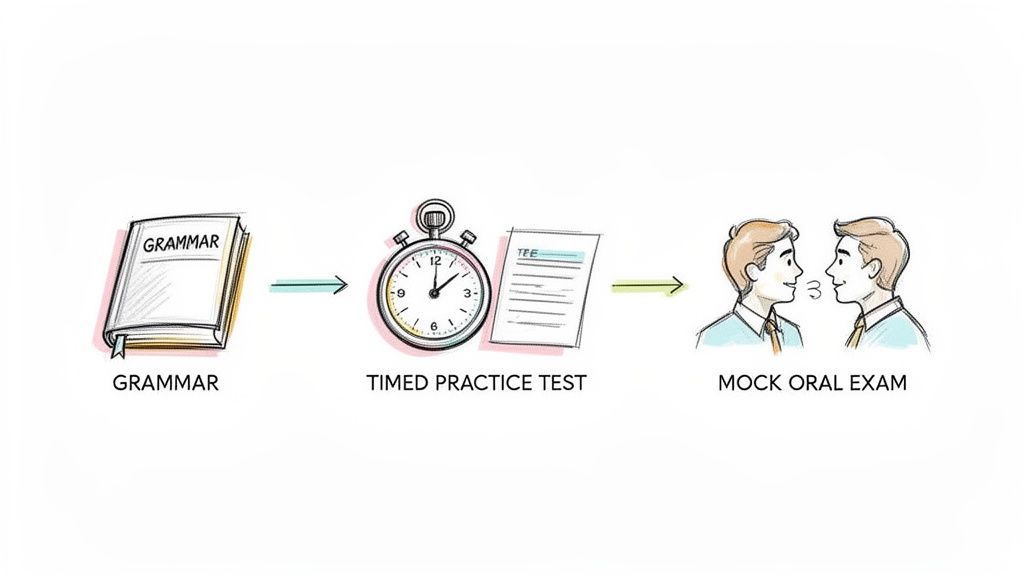
If you want to successfully pass the DELE exam, a thoughtful review plan is absolutely essential. Especially in a busy city like Hong Kong, whether you are a student or a wage earner, time management is the key to success. Developing your own test preparation schedule can help you allocate your energy in a more systematic way and move towards your goals step by step.
As for how long the timetable is, it depends on your own level and target level. Generally speaking, we would recommend candidates to reserve at least three months to one year. This time is not only used to learn language knowledge, but more importantly, to develop on-the-spot reactions and proficiency required for exams.
Long-term strategy: A one-year exam preparation plan
If you have a year or more, congratulations, this is the most ideal preparation mode. You can break the learning process into several stages, proceed step by step, and lay a good foundation.
The first 6 months - Consolidating the foundation : The focus of this stage is to systematically learn grammar and expand core vocabulary . Don't rush to make a mock paper. Instead, focus on understanding Spanish sentence structure, verb conjugation rules, and common tenses.
Months 7-9 — Specialized Training : Begin specialized practice on the four core DELE skills (listening, speaking, reading, and writing). For example, this week focus on reading, and next week on writing.
The last 3 months - Mock sprint : fully devote yourself to doing the mock exam, strictly follow the exam time to complete the component papers, identify your own weaknesses and make targeted improvements.
Learning in stages like this can ensure that you have solid basic language skills before entering high-intensity practice, and will not get stuck due to an unstable foundation.
Mid-term deployment: Six-month test preparation plan
If it takes half a year, we need to be more strategically focused and focus our time and energy on the most efficient links.
Your first task is to quickly review the grammar and vocabulary required for the target level, and then immediately start practicing specifically. For example, listen to a podcast every day, write one or two articles every week, and then find opportunities to practice speaking with others.
Around the third month of preparation, you should start taking complete mock tests regularly to get used to the rhythm and pressure of the exam.
Short-term sprint: A three-month test preparation plan
If you only have three months, you must be mentally prepared for a high-intensity sprint. The core strategy at this stage is "fighting to support war."
Crazy writing : Doing a lot of past papers and high-quality mock tests is the most effective way to improve your test-taking skills in the short term.
Time management : Each exercise must be strictly timed to train your ability to think quickly and answer questions under pressure.
Accurate review : After completing each paper, be sure to spend time analyzing the reasons for the errors. Is it because the vocabulary is not enough, the grammar is not clear, or the type of questions is not familiar? Then make targeted remedies.
In Hong Kong, the curriculum designs of many higher education institutions have proven the effectiveness of this kind of systematic learning. For example, the Spanish course of the School of Professional and Continuing Education at the University of Hong Kong (HKU SPACE) strictly corresponds to the CEFR standards and provides a complete ladder from A1 to C1, allowing learners to plan their learning blueprint step by step. To know more about the comparison of different Spanish schools in Hong Kong , you can refer to our detailed analysis.
No matter which schedule you choose, remember that perseverance is the only secret to success.
A useful resource library to help you maximize your listening, speaking, reading, and writing scores.
If you want to pass the DELE exam, just chewing the grammar is definitely not enough. The real key to success is knowing how to make good use of the tools and resources available to you, coupled with practical test-taking skills.
Preparing for DELE is like running a language marathon. Not only does it require you to have endurance, but you also need to find running shoes and know a certain pace. In this section, we have selected a series of learning resources to break down the four major levels of listening, speaking, reading and writing one by one to help you train in a targeted and efficient manner.
How can I improve my reading and writing?
For reading comprehension, the goal is very clear, which is to quickly and accurately grasp the key points of the article within the time limit; while for writing, it requires clear structure and accurate wording.
Official mock test : The first stop must be the official website of Instituto Cervantes. Download all previous official mock papers to practice the basic skills, which can help you familiarize yourself with the question types, difficulty and control at the same time.
News App : Develop the habit of reading Spanish news every day. Just like El País or BBC Mundo mobile apps, there are enough types of articles, ranging from current affairs to daily life, which can help you adapt to different topics and writing styles.
Grammar checking tools : After you practice writing, you can use free online tools like SpanishChecker or LanguageTool to check for low-level grammatical errors. This step is so important as it can slowly develop your ability to correct yourself.
Warm reminder: When writing, do not use complicated and unusual words. The most important thing is to be able to express your opinions clearly and accurately. Instead, try to skillfully use some connectors (conectores), such as "sin embargo", "además", "por lo tanto", and the structure and flow of the article will immediately rise to a new level.
What are some practical exercises for listening and speaking?
The most annoying thing about listening is that you encounter accents from different regions every day; speaking, on the other hand, tests your immediate response and fluency, and there is no back-up.
Featured Podcasts : Listening to podcasts during your daily car ride is definitely a great way to improve your listening skills. Notes in Spanish is divided into different levels, suitable for beginners and intermediate learners; and Radio Ambulante allows you to get in touch with real stories and accents from various parts of Latin America. Once you become proficient, you will not be afraid of the accents in the exam room. For more specific ways to improve your listening skills, check out our Spanish listening skills guide .
YouTube channel : With visual aids, it will be much easier to understand. Channels like Why Not Spanish? and Español con Juan use life-like and humorous ways to explain language knowledge and culture, which are very suitable for the tastes of Hong Kong learners.
Language Exchange App : Don’t be afraid of being ugly! Use apps like Tandem or HelloTalk to find native speakers for language exchange. This is the most direct, cost-effective way to practice speaking, and it can help you get used to the rhythm and pressure of talking to real people.
Although our Hong Kong students grow up in a multilingual environment, it takes continuous efforts to truly master a new European language. Spanish is a language spoken by more than 500 million people around the world, and the learning population in Hong Kong actually has huge growth potential. Knowing how to make good use of these global learning tools is a key step for you to stand out among many candidates.
Finally, integrate these resources into your daily review plan, and over time, with perseverance, you will be pleasantly surprised to find that you have made great progress in all aspects of listening, speaking, reading and writing.
Need professional guidance? The Hong Kong Spanish Cultural Association can help.
Want to take the DELE exam but find it a bit difficult to do it alone? Want professional guidance but don’t know where to start? Many people are like this. Although self-study can lay a good foundation, once on the battlefield, faced with DELE's tricky question types and extremely strict time limits, many times you will be in a hurry. At this time, guidance from an experienced teacher is definitely the key to finishing the job.
Our team at the Hong Kong Spanish Cultural Association exists to help Hong Kong candidates cope with DELE. We are well aware of the neck problems that everyone will encounter when preparing for competition, so the courses designed are aimed at these pain points, and the goal is to help you use the most efficient method to achieve good results.
What is so special about our teaching?
What we are most proud of is the strong team of more than 30 experienced native Spanish teachers behind us. Not only do they know the DELE exam structure, question types and scoring standards well, but more importantly, they can teach you the most authentic and natural Spanish - this is especially important in the oral exam (Oral) part that emphasizes real communication.
We insist on small class teaching (maximum 6 people) and say goodbye to the traditional "one-way" teaching where the teacher speaks on the stage and the students listen in the audience. In our place, the learning atmosphere is relaxed, and every student has plenty of opportunities to interact with the teacher. It is good to ask questions, practice answers well, and the teacher can give immediate feedback. Especially for the oral examination and writing, which require a lot of practice, the effect of this kind of personalized guidance is really very different.
Our study centers in Tsim Sha Tsui and Causeway Bay are both located in the city center, and the transportation is very convenient. Whether you come to study after work or want to attend class on the weekend, we are sure to find you.
Courses tailor-made for DELE candidates
All our course content is designed around the DELE exam, ensuring that every minute and every second you learn is used wisely.
Practical test-taking strategies : From time allocation, speed reading skills, to beautiful writing structures, the teacher will teach you all the practical "exam secrets".
Dismantling past test questions : We will take everyone to analyze the past paper, see through common question traps, and master the rules of question setting.
Key training in oral and writing : We will provide a large number of simulation exercises for Hong Kong students in areas where they are weak. The teacher will also provide personalized correction suggestions for each assignment and practice one by one.
We firmly believe that the more prepared you are, the greater your confidence will be. If you want to know more detailed information about DELE exam preparation courses , you can go to our page.
Want to experience our professional teaching firsthand? Don’t wait, take the first step to success now! Hurry up and contact our course consultants via WhatsApp to ask for details, or make an appointment for a free proficiency assessment and trial . We will help you plan the best DELE exam preparation path for you!
DELE Exam Frequently Asked Questions (FAQ)
On the way to prepare for the DELE exam, you will always encounter various questions such as "listen to the speech..." and "what if... you can do it?". Don’t be alarmed, we have gathered together some of the most common problems encountered by Hong Kong candidates and will break them down for you in one go, so that you can concentrate on sprinting with peace of mind!
Q1: How many times does DELE have exam opportunities in a year? How early do I need to register? Isn’t it full?
The most important DELE exam months in Hong Kong are usually between May and November . Because the seats for these popular levels of B1 and B2 fill up quickly, registration usually closes two or three months before the exam. We strongly recommend that you pay attention to the CityU SCOPE official website at least 3 to 4 months in advance , and act as soon as registration opens to avoid missing out.
Q2: Reading is good but Writing is not good. How can it be considered as qualified?
No calculation. DELE adopts a "group scoring system" and does not count total points. Reading and Writing (Grupo 1) and Listening and Speaking (Grupo 2) are two independently scored groups. You must reach the passing score in both groups , and you can first get the overall score of "APTO" (passing). Therefore, partiality is a taboo of DELE.
Q3: How good is DELE's Zhang cert? Should I choose B1 or B2?
The DELE certificate is officially issued by the Spanish Ministry of Education and is valid for life . It is widely recognized by universities, companies and government agencies around the world. It is a highly valuable language qualification. As for choosing B1 or B2, it depends on your goals:
B1 is suitable for learners who need to cope with daily life communication and prove that they have a solid foundation.
B2 is suitable for advanced learners who aim to study or work in Spain and need to prove that they can deal with complex topics fluently and naturally.
Q4: How much does the DELE exam cost approximately?
Hong Kong DELE exam fees will vary depending on the level you apply for. According to CityU SCOPE 2024 data, fees range from HK$1,340 for the A1 level to HK$2,240 for the C2 level. For the most accurate charges, please be sure to refer to the latest information published on the CityU SCOPE official website.
Q5: If I become fat, can I take the exam again immediately?
Can. If your results this time are not satisfactory, you can register again in the next examination period. However, we would suggest that you carefully analyze your score sheet first to understand which link you lose the most points in, and then conduct targeted training to make up for it, and then challenge it when you are fully prepared. This way, your chances of success will be much greater.
Q6: What is the difference between DELE and SIELE? Should I take the side exam?
The main difference is:
Validity period : DELE is valid for life; SIELE is valid for 5 years.
Exam format : DELE is a paper-and-pencil exam (excluding oral exam), held only a few times a year on fixed dates; SIELE is a computerized exam, with more flexible exam dates.
Speed of getting results : SIELE will get results in about 3 weeks, while DELE will have to wait about 3 months. If you are looking for a permanently valid and most authoritative certificate for further study or immigration, DELE is the best choice. If you urgently need results or want to test your current level, SIELE is more suitable.
Q7: Is it feasible to study for the DELE exam by self-study?
It's absolutely feasible, but the challenge is also huge. Self-study can help you lay a solid foundation in grammar and vocabulary, but the DELE exam places great emphasis on test-taking skills, time management and naturalness of oral interaction. Many candidates will encounter difficulties in writing structure and oral expression. Looking for guidance from an experienced native language teacher can help you conduct efficient training on your weaknesses and save a lot of time on your own exploration.
Q8: Is it necessary for Hong Kong students to take DELE?
Currently, the only official DELE examination center in Hong Kong is the School of Professional and Continuing Education of the City University of Hong Kong (CityU SCOPE) . All registrations and exams must be conducted through their official channels.
Are you ready to start your DELE score-earning journey? The Spanish Cultural Association of Hong Kong has more than 30 experienced native-speaking teachers and a set of systematic courses specially designed for the exam, which can help you take the exam with confidence. WhatsApp us now to make an appointment for a free level assessment, and we will help you plan the most efficient learning path!
Contact us now: https://spanish.hk