
Hong Kong Government Free Courses 2026-27: A Complete Guide to ERB, Employees Retraining Board and Free Continuing Education
You may be facing a very real choice: you want to change jobs, get a promotion, or learn AI, but you're overwhelmed by the different names, income thresholds, and application forms for "free courses from the Hong Kong government." The most worthwhile option to check first for the 2026-27 academic year is the ERB (Employees Retraining Board) course , but "free" isn't automatically available to everyone; the actual cost will vary depending on the course type, employment status, income, and individual admission requirements.
If you are unemployed, job-seeking, or out of school, you should first look at free employment-linked courses and retraining subsidies. If you are employed, you should first determine whether you are eligible for tuition subsidies or fee waivers for non-employment-linked courses based on your income. To quickly compare different government-funded pathways, you can first refer to this list of government-funded courses , and then return to the ERB official course search system to verify the latest class schedules.
Table of contents
2026-27 ERB and Government Free Continuing Education Overview - First, distinguish between the four types of ERB courses.
ERB's four types of courses have different target groups and funding differences - first, screening is based on employment status - documents and time are also costs.
Practical Guide to Monthly Income Tier Subsidies and Full Tuition Waivers - Income Verification Before Applying - Five Frequently Asked Questions and Remedial Measures
2026-27 Key Registration Timeline - Actions Arranged in Stages
Comparison of the added value of AI digital skills and language training
Continuing education matching recommendations for readers of different backgrounds : Parents should first check youth training programs ; students should first check their status classification ; employed individuals should first verify their income and available time ; unemployed and laid-off individuals should prioritize employment-related programs.
Myths about Further Education and Common Reasons for Rejection
Action list and official query summary - Completed within 24 hours - Completed within one week
Overview of ERB and Government Free Training in 2026-27
The 2026-27 fiscal year is noteworthy because the ERB has officially designated April 2026 to March 2027 as the new curriculum overview year. The official page lists employment-linked courses, general skills courses, courses for specific service groups, and youth training courses. This indicates that "2026-27" is not merely a general term used to refer to long-term policies, but rather a formal annual timeframe for the ERB's actual curriculum development. The ERB's official curriculum page also clearly displays this annual supply framework.
Understanding the annual timeline is important. Courses you find mid-year may not represent a fixed supply throughout the year; class schedules are updated on a rolling basis according to region, skills needs, and training institutions. The official ERB 2026-27 course overview was printed in April 2026 and is available in print and online. The course search page also shows actual start dates, regions, and teaching modes. The official course overview shows that several AI and business application-related courses have appeared in August and September 2026, located in Kwun Tong, Tuen Mun, Wan Chai, Yuen Long, Prince Edward, and Central.
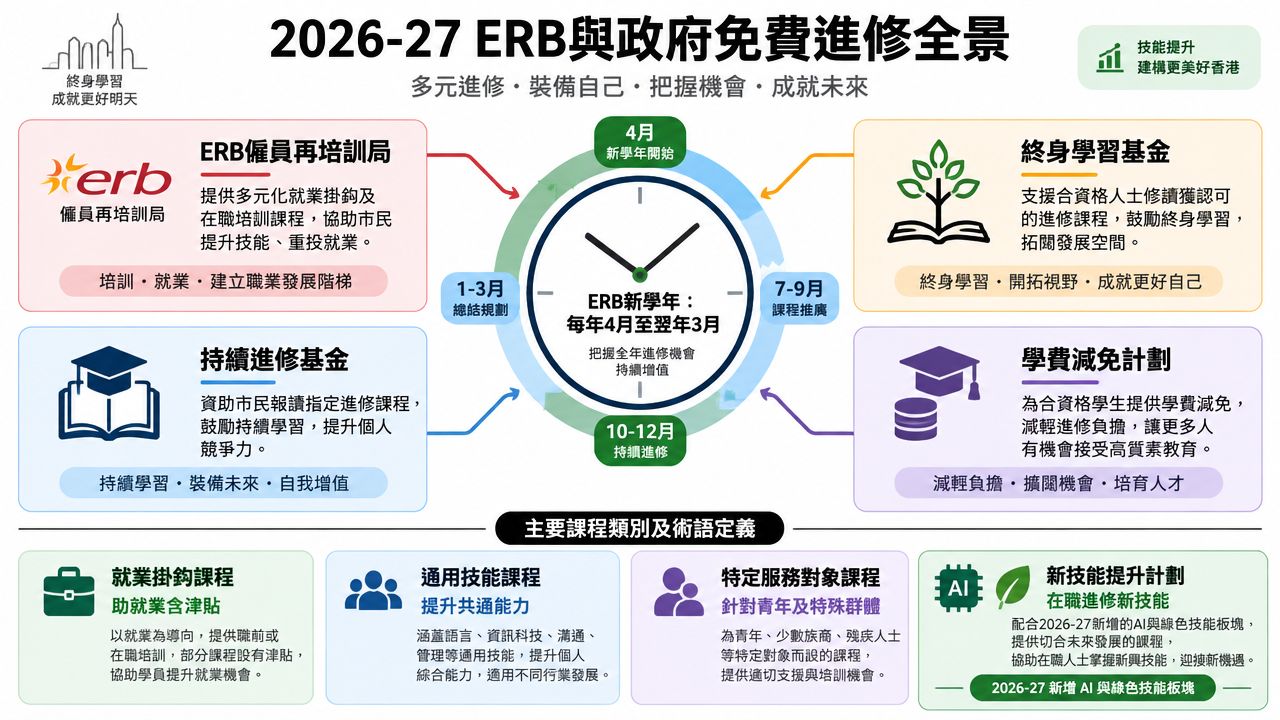
First, distinguish between the four types of ERB courses.
Job-linked courses : These courses are primarily designed for the unemployed, those seeking employment, or those who have dropped out of school. The goal is to equip them with job-related skills, and qualified participants can receive retraining subsidies.
General skills courses : These are geared towards working professionals and adult learners, and are typically offered in the afternoon or evening to improve digital, language, and workplace skills.
Targeted service courses : designed for the needs of specific groups, such as youth, ethnic minorities or other designated service recipients, and eligibility cannot be based solely on age.
Youth training courses : These courses are designed to improve young trainees' pre-employment skills, job preparation, and skills development. The curriculum differs from that of general adult courses.
As for the Lifelong Learning Fund, Continuing Education Fund and Tuition Remission Scheme, they cannot simply be regarded as another name for ERB. They handle different applicants, course scopes and funding methods. The safest way is to first determine whether you want "job search", "on-the-job upgrade", "language skills" or "supplementary academic qualifications", and then choose the right plan.
The consultant suggests: Don't search for "cheapest courses" first. Write down your employment status, monthly income, available class times, and target job first, and then compare the financial support.
Differences in target groups and funding for the four types of ERB courses
ERB courses are not a single product. The most common mistake is to confuse "free," "funded," and "subsidized" with each other. In reality, the course category determines whether you are on the employment-oriented track, while income and status will affect the payment arrangements for non-employment-linked courses.
First filter by employment status
Employment-linked courses are suitable for the unemployed, those seeking employment, or those out of school. The focus of these courses is on job skills and re-entering the workforce. ERB official data states that unemployed Hong Kong permanent residents, holders of one-way permits, or dependents sponsored by Hong Kong permanent residents are eligible to enroll in these free courses. If the course is seven days or longer , eligible participants can apply for retraining subsidies. The ERB course overview also shows that these courses differ from typical on-the-job training programs and are generally more time-consuming.
General skills courses are more suitable for those who are still employed but want to improve their existing skills. Part-time or evening arrangements are more practical for working professionals, but whether they are completely free cannot be generalized. Non-employment-linked courses will be handled according to the ERB's income tier system.
Admission requirements for specific service groups and youth training courses should be reviewed individually. Courses may have similar names, but the target audience, teaching methods, and follow-up support may differ. Do not judge a course solely based on the words "youth" or "funded".
Course Category | object | Training allowance | Typical duration | Follow up after completion |
|---|---|---|---|---|
Job-linked courses | Unemployed, jobless, or out-of-school individuals | Those who qualify for a course of seven days or more can apply for a retraining subsidy. | Depends on professional skills and course requirements. | Focusing on employment orientation and related follow-up |
General skills courses | Working professionals and general adult learners | Revenue from non-employment-linked courses will be categorized and processed accordingly. | It is commonly a half-day or evening schedule. | Focus on skill improvement |
Targeted Service Courses | Specified group | Arranged according to course and target audience | Depends on the course design | Depending on whether the course includes dedicated support |
Youth training courses | Young students | Handled according to the regulations of the youth curriculum. | Depending on the course and training model | This may include pre-employment preparation and job search support. |
Documents and time are also considered costs.
Applicants generally need to prepare proof of identity and the course requirements. Individual courses may have additional licensing, industry, or legal requirements. The ERB application form also reminds applicants that being 15 years of age or older is only one of the basic requirements and does not mean that they can directly enroll in any course. The ERB course application form specifies that applicants must be qualified employees in Hong Kong and meet the individual course admission requirements; those enrolled in full-time non-ERB education courses, or those on leave or holidays, are generally not eligible.
Practical application of monthly income tiered subsidies and full exemption qualifications
The core issue with non-employment-linked courses is not "whether there is government funding," but rather which income bracket you fall into. ERB official data states that individuals earning over $15,000 but no more than $23,500 per month can apply for tuition subsidies; those with no income or earning no more than $15,000 per month can apply for tuition waivers. The ERB course fee and eligibility guidelines also list three tiers for non-employment-linked courses: standard course fees, subsidized tuition, and tuition waivers.
Income verification must be done before applying.
Don't rely on estimations. First, compile documents that reflect your current income situation, then confirm the acceptable format with the training institution. Prepare the following documents first:
Employee income : Recent pay slips and income verification provided by the employer.
Bank records : Monthly statements that reflect income deposits.
Mandatory Provident Fund (MPF) records : Used to assist in verifying employment and contribution status.
Other income : For part-time jobs, self-employment, dividends, or family allowances, you should directly consult the ERB to inquire whether it needs to be reported and how to calculate it.
The key point about these documents is not "the more the better," but that the information must be consistent. If the income figures on the payment slips, bank statements, and application forms contradict each other, the training institution may request supplementary information, delaying the approval process.
Practical judgment: The question you should ask is not "Can I take it for free?", but "What category does the course I enroll in belong to, and what fee level will my income certificate classify me into?"
Five common problems and remedies
If your documents are overdue or cannot be submitted on time, contact the training institution immediately to confirm whether they can still be submitted. If the course has already closed, ask them to explain the next available registration date; do not assume that there are still places available.
If your income exceeds the application level, first verify the income calculation period and reported items, especially for part-time, self-employed, or other regular income. If the information is correct, recalculate the actual cost based on subsidized tuition fees or general course fees.
Incorrect course category: Unemployed individuals seeking subsidies should prioritize checking whether the course is employment-linked, rather than simply looking at the course name. Confirm the employment status requirements with the training institution before enrolling.
Attendance is a concern, as the allowance is linked to attendance requirements. Before registering, assess any conflicts with transportation, family, or work; otherwise, even with a tuition waiver, you may not be able to complete the course.
Not meeting the identity or admission requirements : Being 15 years of age or older does not guarantee eligibility for all courses. If a course involves a license, academic qualifications, industry experience, or a specific status, please prepare the corresponding proof before deciding whether to enroll.
If you want to compare whether you should take another funding route for language learning, you can refer to the application process for the Continuing Education Fund and Spanish courses , but ultimately the decision should be based on whether the course meets the relevant program requirements.
2026-27 Key Registration Timeline
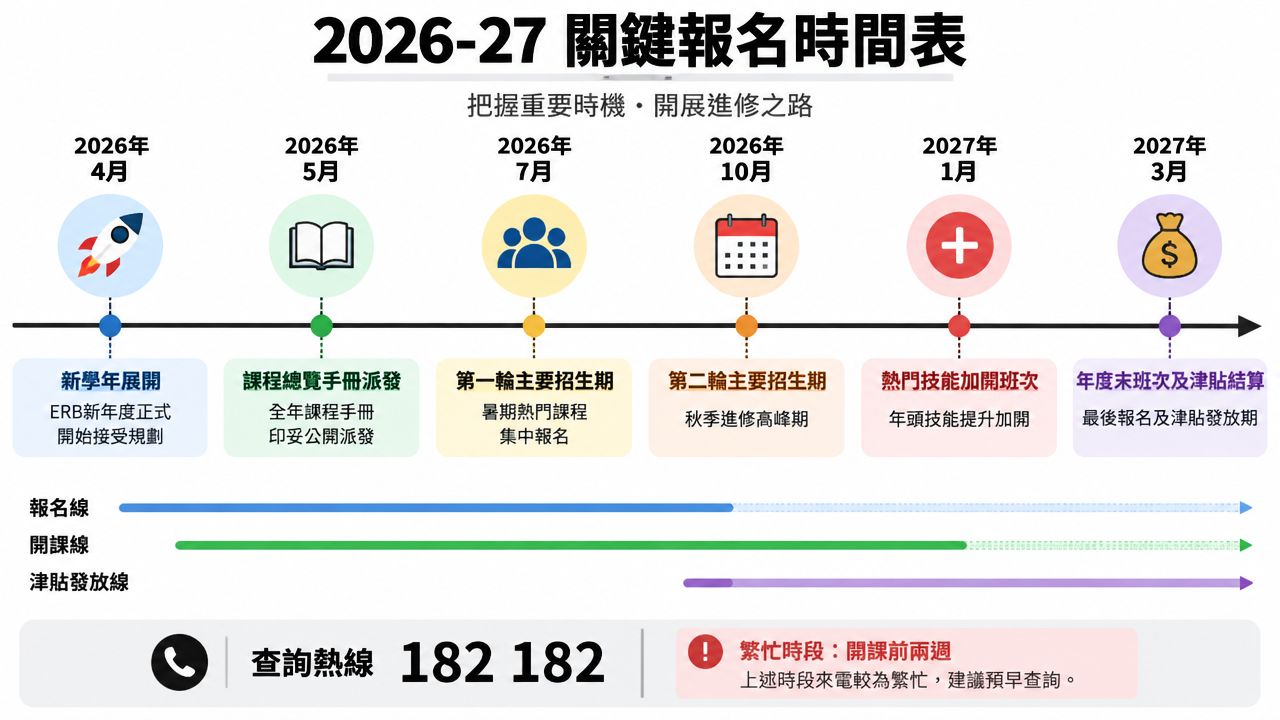
The ERB 2026-27 academic year runs from April 2026 to March 2027. Official course information is compiled on an annual basis, but actual class schedules will be updated according to region, teaching mode, and skill requirements, so don't wait until the month you want to enroll to search for the first time.
Actions are arranged in stages.
April 2026 : The new year's course arrangements begin. First, confirm which type of course you are eligible for, and then search for the region and class mode.
May 2026 : The 2026-27 course overview was printed in April. This is a good time to download or view the complete information and build a shortlist.
July 2026 : Summer and regional classes may be of more interest. Parents, job seekers and the unemployed should check the enrollment requirements in advance.
October 2026 : Working professionals can re-examine evening or half-day courses to avoid focusing solely on searching for full-day classes.
January 2027 : Pay attention to new classes in artificial intelligence, business applications and other skills courses, and at the same time confirm whether your proof of income is still valid.
March 2027 : There are still classes available at the end of the year, but do not leave registration, document verification and class arrangements to the last stage.
The timing of receiving the retraining allowance cannot be determined solely by the registration date. Only those who meet the course category, attendance, and application requirements are eligible to receive the relevant retraining allowance. The eligibility criteria for the employment-linked course allowance must also be confirmed with the training institution before registration.
The hotline 182 182 is a useful inquiry channel, especially when you are unsure about course details, document formats, or how to handle proof of income. The most effective approach is to call only after you have identified a specific course, and prepare the course number, start date, and your employment status. This will likely get you a clearer answer than simply asking "What free courses are available?"
Comparison of the added value of AI digital skills and language training
The 2026-27 ERB course list now includes several part-time AI-related courses, such as the Certificate in Design, Implementation and Application of Artificial Intelligence and the Certificate in Commercial Applications of Generative Artificial Intelligence . These courses are located in various districts including Kwun Tong, Tai Wai, Prince Edward, Cheung Sha Wan, Yau Ma Tei, Central, Wong Tai Sin, and Tsing Yi, reflecting a shift in course offerings from traditional vocational and technical training to AI application-oriented skills. The course page for the Certificate in Design, Implementation and Application of Artificial Intelligence can be used to check specific classes, rather than simply relying on the course name.
The advantage of AI courses is that the learning objectives are usually more focused, making them suitable for people who want to quickly get in touch with generative tools, business applications, or digital workflows. Language learning, on the other hand, requires accumulation, especially when the goal involves further education, workplace communication, exams, or long-term career changes. Completing a course in a short period of time does not equate to immediate fluency.
Comparison Items | AI digital skills | Language Learning |
|---|---|---|
Main purpose | Understanding tools, application processes, and digital working methods | Develop understanding, expression, and workplace communication skills. |
Suitable partners | People who want to improve their digital work efficiency or switch to technology applications | People who want to pursue further education, change jobs, serve clients, or develop cross-cultural skills. |
Learning Model | It can be approached from a single application scenario. | It usually requires gradual accumulation according to degree. |
Time Report | Suitable for quickly developing a demonstrative skill. | Suitable for long-term, sustainable development capabilities |
Pre-enrollment check | Does the course require basic digital skills? | Is the course level appropriate for your language proficiency? |
Main risks | Learning only the names of tools without connecting them to actual work. | The level is too high or too low, causing learning to stop midway. |
I don't recommend everyone chase AI. If you already have a clear need for digital tools in your work, AI courses are easier to implement; if you need to deal with overseas clients, process foreign language documents, or prepare for entrance exams, the value of language courses depends more on continuous use than on short-term completion.
If you want to learn a language with flexible hours, you should first understand the actual advantages and disadvantages of online learning . Whether you choose AI or language learning, you should first ask yourself: After completing it, can I demonstrate concrete results in my resume, interviews, work, or exams?
Recommendations for continuing education pairing for readers of different backgrounds
Choose courses based on your social status, not popularity. Parents, students, working professionals, and the unemployed face completely different limitations. Forcing the same course onto everyone usually just wastes time.
Parents should first check youth training programs.
If you are a parent, the focus should not be on finding the "cheapest" course for your child, but rather on confirming whether your child's age, academic status, and course schedule are suitable. Youth training courses can serve as an entry point for workplace English, basic information technology, and job preparation, but the conditions of each individual course must be verified one by one.
When preparing the documents, first organize your child's identification documents and the required academic qualifications or enrollment information for the course, and then directly inquire with the training institution about the registration method. If your child is still enrolled in a full-time non-ERB education course, the ERB application form usually specifies eligibility restrictions, and you should not immediately pay or request leave simply because your child meets the age requirements.
Students should first check their identity classification.
Students wishing to pursue further education during the summer should first check whether the specific service recipients or youth training courses accept their current student status. The terms "summer" or "youth" in the course name do not mean that all students can participate; ultimately, it depends on the target audience and admission requirements specified in the course.
Before registering, prepare your school or institution certificate, identification documents, and available class dates. If your goal is to build a resume, you should choose a skill that is related to your future academic or career path, and not enroll in a course simply because it is free.
Employed individuals should first verify their income and working hours.
For working professionals, general skills courses are the most suitable to start with, especially part-time or evening programs. Regarding income, those earning less than $15,000 per month or having no income can apply for a fee waiver; those earning more than $15,000 but less than $23,500 per month can apply for tuition assistance. The ERB's official fee schedule is the primary basis for determining the actual cost.
In terms of time management, please prioritize commuting, overtime work, and family responsibilities. No amount of financial aid can compensate for lost time if the course cannot be completed.
The unemployed and underemployed should be given priority consideration for employment linkage.
If you are currently unemployed, job-seeking, or out of school, I would suggest searching for job-linked courses first. This approach is more direct, with courses focusing on job skills. Those who qualify for courses of seven days or more can also apply for retraining subsidies according to regulations.
After preparing your identification, admission requirements documents, and employment status information, use the ERB course search system to filter by region and class format. Don't just look at "free" options; compare whether the course matches the position you want to apply for and whether you can complete the entire course schedule.
Myths about Further Education and Common Reasons for Rejection
The most common mistake in ERB applications isn't finding a course, but rather confusing basic eligibility, course eligibility, and fee eligibility. The following misconceptions will directly impact your chances of successful application.
Common Misconceptions | ERB Official Guidelines | Corrective Action |
|---|---|---|
Anyone who is 15 years or older is guaranteed to register. | Being 15 years of age or older is only a basic requirement; one must also be a qualified employee in Hong Kong and meet the specific course requirements. | First, read the course admission requirements, then check your current enrollment and immigration status. |
All ERB courses are free. | The funding arrangements for employment-linked courses and non-employment-linked courses differ. | Confirm course category and income level |
Employed individuals can also apply for employment-linked subsidies. | The job-linking course is designed for the unemployed, job-seeking, or out-of-school individuals. | Declare your employment status truthfully on the registration form. |
Anyone who registers will receive a retraining allowance. | Only qualified students who have completed a seven-day or longer job-linking course are eligible to apply according to the regulations. | Please confirm the subsidy conditions, attendance requirements and application procedures before registering. |
The course name is the same, anyone can retake it. | Some courses may have existing enrollment, admission, or industry requirements. | Check with the training institution to see if they accept individuals who have previously taken similar courses. |
The official application guidelines clearly state that some courses may involve licensing or legal requirements; students enrolled in full-time non-ERB education courses, or those on leave or during holidays, are generally not eligible for ERB courses. The ERB application documents should be read before registration, not only when requested for additional documents.
Another common mistake is misunderstanding "fee waiver" as "no cost whatsoever." Even if tuition is waived, you still bear the costs of transportation, time, materials, or the opportunity cost of losing work due to attending classes. For the unemployed, it is especially important to verify whether the course is a seven-day or longer job-linked course and whether retraining subsidies are applicable.
Summary of call logs and official queries
You can complete the first round of screening in one day. First, fill in four pieces of information: whether you are currently unemployed, job-seeking, employed, or a student; your approximate monthly income level; whether you can attend full-time, half-day, or evening classes; and which industry you hope to switch to.
Complete within 24 hours
Open the official search : Go to the ERB course search platform to view course names, regions, start dates, and teaching modes.
Create a shortlist : Only keep courses that match your job situation and availability; don't be attracted by "free" options.
Prepare the following basic documents : proof of identity, academic qualifications or licenses required for the course, and documents that reflect income.
Call 182 182 : Bring the course name and class information to inquire directly about the fee level, admission requirements, and eligibility for subsidies.
Complete within a week
Download the annual course overview : Use the PDF search function to find courses in AI, business applications, languages, or your target industry.
Verify proof of income : Compare food receipts, bank records, or other income documents with the information on the application form.
Confirm registration method : Confirm with the course training institution whether the application is online, in person, or in other ways, and whether original documents are required.
Allow time for classes : Take into account transportation, work, and family responsibilities to avoid affecting course completion and allowance applications due to absence.
Do not overlook the addresses and office arrangements of the regional service centers. The ERB course search page provides class information, while the official annual course overview helps you understand the complete course framework; for lifelong learning funds and other inter-institutional funding, you should verify on the relevant official pages and not rely on content reposted on social media platforms as the final basis.
If you wish to begin your studies in language skills, the Hong Kong Spanish Cultural Association offers Spanish courses for adults, children, and teenagers. Centres are located in Tsim Sha Tsui and Causeway Bay, with small-group classes taught by native-speaker tutors and free placement assessments. Please check if the courses are suitable for you based on your income, eligibility for subsidies, and learning goals before making a registration decision.
The Spanish Cultural Association of Hong Kong offers Spanish courses from beginner to advanced levels, with options for adults, children, teenagers, private lessons, and exam preparation, allowing you to schedule your language learning according to your time and goals. You can first learn about the courses and schedule a free placement assessment through the Spanish Cultural Association of Hong Kong , and then coordinate your language learning with your personal learning plan for the 2026-27 academic year.