
Is Spanish worth learning? Is Spanish hard to learn? A complete analysis of education and career prospects in Hong Kong.

Is learning Spanish worthwhile? The answer is: absolutely . For Hong Kong students and working professionals, Spanish is not only easier to learn than you might imagine, but it is also a highly rewarding strategic investment in further education (such as HKDSE and IB) and career development, a secret weapon to help you break through.
Key points of the article
Low learning threshold : Direct pronunciation, high correlation with English vocabulary, and easier to learn than French and German.
Significant advantages in further education : In public examinations such as the HKDSE, Spanish language candidates have a much higher rate of achieving high scores (5* or above) than those taking mainstream subjects such as Chinese and English.
High career rewards : Open the door to a global market of nearly 500 million people, and be highly competitive in industries such as international trade, finance, and tourism.
The learning path is clear : it can be followed according to the CEFR international framework, from A1 to C2, to achieve the goal step by step.
This article is suitable for:
Students and parents preparing for public examinations such as HKDSE, IGCSE, and IB
For working professionals seeking career breakthroughs and enhanced workplace competitiveness.
For students planning to study abroad or interested in Spanish culture
Want to know your Spanish level or find the most suitable course? The Hong Kong Spanish Cultural Association offers a free level assessment. Feel free to contact us anytime via WhatsApp for inquiries!
Why is learning Spanish a wise investment?
In the cosmopolitan city of Hong Kong, knowing more foreign languages is like having one more trump card. Many people would choose between French, German and Spanish, but if we think about it from the three perspectives of "learning efficiency", "global versatility" and "future opportunities", the advantages of Spanish are obvious.

First of all, the pronunciation of Spanish is very straightforward, many letters are "readable", and it shares a lot of Latin-derived vocabulary with English. For Hong Kong students with a foundation in English, the entry barrier is really low.
Secondly, according to a report by the authoritative Instituto Cervantes , Spanish is spoken by more than 590 million people around the world and is the official language of 21 countries. What does this number mean? Whether you want to travel in depth to Europe, explore business opportunities in South America, or interact with the huge Latino community in the United States, knowing Spanish will definitely make it easier. If you want to know more about the influence of Spanish in the world, you can read our other analysis article on **The increasing popularity of Spanish in China **.
For Hong Kong people who are pursuing academic advantages or career development, learning Spanish is no longer a pure interest, but a strategic investment with a high rate of return. You can spend relatively little time in exchange for high scores in public examinations, and even highlight your uniqueness in the job market.
In order to help you make a clearer decision, we have compiled a comparison table below to quickly take a look at the characteristics of three popular foreign languages from the perspective of a Hong Kong person.
A quick overview of the value and difficulty of learning popular foreign languages (Hong Kong perspective)
This table can help you quickly assess which language is most suitable for your study or career plans in Hong Kong.
Language | Learning difficulty (compared to English) | HKDSE/IB exam advantages | Number of native speakers worldwide | Hong Kong workplace applications |
|---|---|---|---|---|
Spanish | Lower (pronunciation rules, similar vocabulary) | High (fewer test takers, higher percentage of high scores) | About 490 million | International trade, finance, tourism, luxury retail |
French | Medium (complex pronunciation, many grammatical rules) | Medium (Competitive) | Approximately 77 million | Luxury goods, catering, diplomacy, culture and art |
German | Higher (more complex grammar, more noun declensions) | High (fewer test takers, but a steep learning curve) | Approximately 95 million | Engineering, technology, finance, logistics |
After looking at the table, it is obvious that Spanish is the most cost-effective choice for Hong Kong students in terms of learning difficulty and test advantages. Of course, each language has its own unique charm and value. The most important thing is to look at your own goals and interests.
Overcoming Learning Difficulties: Spanish is Easier to Learn Than You Think

When many Hong Kong people hear that they need to learn a European language, their first reaction is "It's so difficult." But actually, Spanish is an interesting exception. Especially for friends who have a foundation in English, the threshold for taking the first step is much lower than you think, thanks to its clear and direct language structure.
This impression of "easy to learn" is not just casual, but is supported by several key language features.
Direct pronunciation: What you hear is what you write
When learning any new language, pronunciation is always the first hurdle. The biggest advantage of Spanish is that its pronunciation is very regular. Most letters have only one fixed pronunciation. There are almost no complex, changeable or even unpronounceable letters like English or French.
To put it simply, as long as you memorize the alphabet readings, you can basically "read by seeing the words, and write by listening to the sounds." This greatly reduces the memory burden for beginners, allowing you to read aloud faster, and your confidence will be restored!
High vocabulary familiarity: Shares Latin etymology with English.
You may not know it, but in fact, more than 60% of English vocabulary is derived from Latin and French, and Spanish evolved from Latin. Therefore, you will be surprised to find that many Spanish words seem familiar to English.
Education
Información (information)
Problema (problem)
Important
This etymological sense of intimacy is like learning a new language, but finding that you have already met one-third of the "friends" in it, and the learning efficiency is naturally doubled with half the effort. Want to know more practical everyday vocabulary? You can read our article ** Spanish Survival Guide for Beginners **.
According to language learning theory, a native English speaker only needs about 600 hours of learning on average to reach the B1 level of Spanish, which is enough for daily fluent communication.
The grammatical structure is clear: the rules are traceable.
Although Spanish verb conjugation is a small challenge to learn, its rules are much clearer and more systematic than those in languages like German. As long as you master the basic tense conjugation rules, you can quickly apply it to most verbs.
At the Hong Kong Hispanic Cultural Association, we have more than 30 experienced native-speaking teachers who will integrate these grammatical rules into daily situational conversations through an interactive mode of small class teaching (maximum 6 people). Learning in this way not only makes grammar less boring, but also ensures that every student has enough opportunities to practice speaking and naturally master verb conjugations in practice, laying a solid foundation for fluent communication.
The Hidden Value of Spanish: Opening Another Door to Education and Career in Hong Kong
Learning Spanish is not only easier than you might imagine, but its true value lies in the unexpected educational and career benefits it can bring in Hong Kong's exceptionally competitive environment. It's not just a hobby; it's more like a smart, strategic investment.
Whether it's the local HKDSE or international courses like IGCSE and IB, for Hong Kong students, choosing Spanish is often a wiser shortcut to higher education. This path allows you to cleverly avoid the "red ocean" of mainstream subjects and strive for more outstanding results in a less competitive field.
Shortcuts to Higher Education: Making Good Use of the Rules of the Exam Game
In public exams, sometimes "choice is more important than effort." Instead of struggling in core subjects where tens of thousands of people are fighting tooth and nail, you might as well switch to the broader track of Spanish and find that the scenery is completely different.
Official data from the Hong Kong Examinations and Assessment Authority (HKEAA) clearly demonstrates the astonishing academic returns of learning Spanish. In the 2023 HKDSE examinations , a remarkable 31.6% of candidates achieved a 5* or higher in Spanish, with 15.8% achieving a 5**!
What does this mean? A comparison will tell you: in the same year, only 0.9% of all candidates achieved a 5** in Chinese, and only 3.7% in English. The data doesn't lie; candidates who chose Spanish have an overwhelming advantage in the percentage of top-scoring students, making them a true game-changer for improving JUPAS scores. For more detailed data, please refer to the Hong Kong Examinations and Assessment Authority's full report .
Career springboard: Creating an irreplaceable unique selling point
In the workplace, having more languages is like having more trump cards, and the value of Spanish is constantly rising. As an international financial and trade hub, Hong Kong has increasingly frequent business exchanges with Spain and Latin American countries, making people who know the language highly sought after.
Mastering Spanish opens doors to a global market of nearly 500 million people in over 20 countries. This skill sets you apart from other job seekers, making you a highly sought-after international talent in the eyes of employers.
The following high-potential industries have a particular need for Spanish-speaking talent:
International Finance and Banking : When you need to handle business with Spanish or Latin American clients, language skills are key to building trust and closing deals.
Trade and Logistics : As the Belt and Road Initiative extends to Latin America, the demand for Spanish-speaking specialists will only increase.
Tourism and hospitality industry : Being able to greet tourists from Spain and South America fluently in Spanish is definitely a big plus for the hospitality industry.
Luxury retail : Many top fashion brands (such as Loewe and Zara) originated in Spain. Understanding their language not only helps in comprehending the brand culture but also enables you to provide attentive service to high-end customers.
For working professionals looking to advance their careers, obtaining internationally recognized language certificates like DELE or SIELE can powerfully demonstrate your language proficiency and significantly enhance your resume. Want to learn more strategies to boost your workplace competitiveness? Consider reading our ** Guide to Spanish Language Learning for Hong Kong Working Adults **.
In conclusion, the value of learning Spanish goes far beyond the language itself. It is a key to achieving academic and career breakthroughs in Hong Kong.
Plan your learning path: From zero to fluent communication
After understanding the value of Spanish and how easy it is to learn, the next natural step is to tailor a clear learning route for yourself. Many people ask, "Is Spanish worth learning?" The answer is actually not just the language itself, but more importantly, how you can achieve your goals systematically and step by step. Whether you are a parent paving the way for your children, a middle school student preparing for public examinations, or an adult who wants to increase your self-esteem, it is very important to set clear staged goals.
The flow chart below clearly shows how learning Spanish can help you gain points in your studies and career.
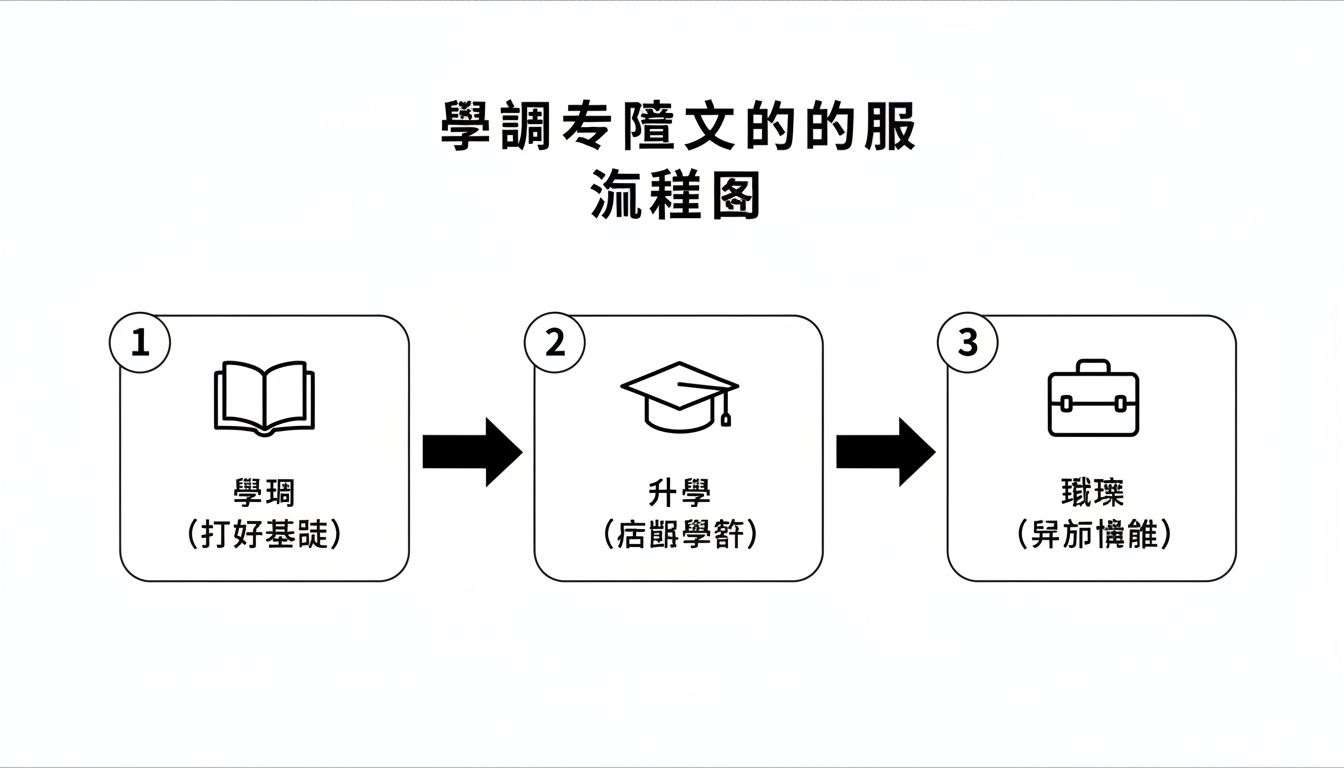
Starting from laying a solid language foundation, slowly building up your advantages for further studies, and eventually turning them into unique workplace competitiveness, every step is a worthwhile investment.
Set goals according to learner type
Everyone’s motivation for learning is different, so goals naturally need to be “tailor-made”. The Spanish learning market in Hong Kong is very mature, with everything from interest classes to professional examination courses available, proving that the return on investment is quite high. Statistics show that there are some Spanish schools in Hong Kong that provide trilingual courses and are trusted by parents because of their small class teaching model. At the same time, large companies such as FC Barcelona and Zara also choose professional business Spanish training, which fully proves their commercial value in Hong Kong. If you want to know more information about Spanish schools in Hong Kong, you can read this latest guide.
Parents of young children and primary school students : The goal should be "cultivating interests". Through games, children's songs and interactive stories, children can develop a good impression of Spanish language and culture in a relaxed and enjoyable environment, laying a solid foundation for future learning.
Secondary school students preparing for public examinations (HKDSE/IGCSE/IB) : The goal is to "get test scores." The focus of study should be on the vocabulary, grammatical structure and test-taking skills of the exam syllabus, especially writing and speaking. Our DELE exam preparation course can provide targeted training.
Adult beginners and working people : the goal is "practical communication". You should focus on practical conversations in daily life, travel or business situations, and build up the confidence to speak as soon as possible.
Understanding the CEFR Learning Framework
To make the goals more specific, we can refer to the Common European Framework of Reference for Languages (CEFR) . This international standard divides language proficiency into six levels from A1 (beginner) to C2 (proficient).
CEFR is like a language learning map, clearly marking where you are now and where your next destination is. It helps you understand the listening, speaking, reading, and writing skills you should master at each stage, so that you are no longer confused when learning.
At the Hong Kong Hispanic Cultural Association, our curriculum system fully corresponds to the CEFR framework, ensuring that students can seamlessly transition from the basic to the more advanced. We provide free level assessment , and professional course consultants will help you find an accurate starting point for learning. Whether you have zero knowledge or want to continue your studies, we can match you with the most suitable small class or private course .
FAQ: 5 questions Hong Kong people most want to ask about learning Spanish
1. Is it difficult for native Cantonese speakers to learn Spanish pronunciation?
Easier than imagined! Spanish pronunciation rules are straightforward, and most letters can be "read by sight". The only challenge is to pronounce "rr", but most Hong Kong students can master it as long as they follow the native teacher to practice it in the right way. In our center, teachers will provide specialized skills training to help you pass the test easily.
2. Should beginners choose group classes or private classes?
Depends on your goals and time. If you like an interactive atmosphere and want to get to know your classmates, small class teaching (maximum 6 people) is the best, cost-effective and fun. If you have specific goals (such as taking the IB exam, business purposes) or flexible time, private lessons can be 100% customized for you and are most efficient. We recommend that you make an appointment for a free level assessment first and wait for the course consultant to analyze it for you.
3. How long do I need to learn before I can handle basic communication while traveling?
Faster than you think! Generally, after completing the A1 level course (about 40-60 hours), you will be able to handle basic travel responses such as ordering food in restaurants, asking for directions, and shopping. If you want to achieve it quickly, intensive classes or private lessons can help you achieve your goals in as little as one or two months.
4. Does learning Spanish help with immigration or studying abroad?
Absolutely. Spain is one of the popular non-profit immigration countries, and internationally recognized certificates such as DELE and SIELE are also bonus points when applying to European and American universities. They can highlight your cross-cultural abilities and stand out among many applicants.
5. Is it good to learn Spanish?
The most important thing when choosing a school is the teachers, class size and location. The Spanish Cultural Association of Hong Kong has more than 30 experienced native-speaking teachers and insists on small class teaching with a maximum of 6 people to ensure the quality of teaching. We have centers in Tsim Sha Tsui and Causeway Bay, which are conveniently located. Many students have praised us for our good reputation. You are welcome to book a free trial class to experience it for yourself!
Ready to embark on your Spanish language learning journey? The Hong Kong Spanish Cultural Association , with over 30 experienced native language teachers, insists on small class sizes, and has campuses in Tsim Sha Tsui and Causeway Bay, making it your most reliable choice. Book a free trial lesson or course consultation now via WhatsApp, and let us plan the most suitable learning path for you! Book a free trial lesson now