
A Guide to Spanish learning for Adults: A Complete Guide for Hong Kong Working Professionals

Updated: Feb 5
For Hong Kong office workers, learning adult Spanish is no longer just about traveling and taking photos; it's more like making a crucial and strategic move in their career development. Mastering this language, spoken by nearly 500 million people worldwide, is like opening the door to the Latin American and European markets, where enormous business potential awaits discovery, adding irreplaceable competitiveness to your resume.
This article's key takeaways
Why learn it: Mastering the world's second most spoken language (with over 460 million users) can directly enhance your competitiveness in international business, travel, and cultural exchanges.
Course selection: Mainstream courses in Hong Kong include small group teaching, one-on-one private classes, large institutions and online courses. You should choose according to your personal goals, budget and time flexibility.
School Selection Tips: When choosing a school, you must consider the teaching staff (native language teachers and teaching certifications), curriculum structure, location convenience (such as Tsim Sha Tsui, Causeway Bay) and student reputation.
Overcoming obstacles: Adjusting mindset, making good use of spare time, adopting smart memorization techniques, and practicing in safe environments such as small group classes are key to successful adult learning.
Learning blueprint: Plan the progress based on CEFR international standards (A1-C2) and consider obtaining international certifications such as DELE or SIELE to demonstrate capabilities.
Who is this guide for?
For working professionals looking to enhance their competitiveness in the workplace.
Adults planning to work, study, or travel in Spain or Latin America
Learners who are passionate about Spanish culture and want to enhance their self-worth.
Are you comparing different Spanish courses in Hong Kong and looking for the best option?
Want to immediately assess your Spanish level or book a free trial lesson? Feel free to contact us anytime via WhatsApp. The professional team at the Hong Kong Spanish Cultural Association will provide you with personalized advice.
Is learning Spanish the best self-investment for Hong Kong workers?
In this globalized world, knowing another language is like having an extra ticket to access more opportunities. Spanish is not only a bridge for cultural exchange, but also a very practical business tool. Especially for people in Hong Kong, an international financial center, the rewards of this skill are far more substantial than you might imagine.
What are the advantages of mastering the world's second most popular native language?
The most direct benefit of learning Spanish is that you can communicate "at zero distance" with over 460 million native speakers worldwide, a number second only to Chinese. Whether you want to explore emerging markets, build deeper trust with international clients, or strive for a more important role in a multinational corporation, fluent Spanish will be an unexpected secret weapon.
Furthermore, in recent years, the interest of adults in learning Spanish in Hong Kong has skyrocketed. This is undoubtedly related to Spanish's status as the world's third most used online language, with a staggering 344 million internet users. According to our students at the Hong Kong Spanish Cultural Association, more and more working professionals are recognizing the importance of this language and are opting for efficient learning through small-group classes. You can learn more about their motivations for learning from their real-life experiences .
Enhance personal competitiveness while activating the brain.
Beyond the advantages in the workplace, the benefits of learning a new language for personal growth are numerous. Many studies have confirmed that learning a foreign language can:
Enhance cognitive flexibility: Improve your problem-solving and multitasking abilities.
Slowing down brain aging: Frequently switching between different languages is like giving your brain a workout, helping to keep your mind sharp.
Broaden your cultural horizons: gain a deeper understanding of the rich and diverse culture, art, and history of Spain and Latin America.
For Hong Kong adults pursuing career and personal growth, learning Spanish is a highly rewarding self-investment. It not only opens doors to global business opportunities but also enriches your inner qualities, allowing you to radiate a different kind of depth and charm in both life and work.
So whether you're looking for a promotion, a job change, or simply want to improve yourself, now is the perfect time to start learning adult Spanish .
Comparison of mainstream adult Spanish courses in Hong Kong
There are a dizzying number of adult Spanish course options on the market, ranging from large chain centers to small class teaching, with a variety of models. After all, what is best for you first? To find the answer, the key is actually very simple: first figure out your learning goals, time and budget, and then choose the class mode that suits you best.
Mainstream adult Spanish classes in Hong Kong can be roughly divided into four categories: small class teaching, one-on-one private classes, large-scale institutional courses, and the currently popular online courses. Each model has its good and bad, and different needs for different people. For example, there are some migrant workers who want to be fast, handsome, and want personal guidance from teachers; there are also people who like to study together with their classmates, talk and laugh, and the atmosphere is good.
To help you think more clearly, the following decision chart analyzes the motivations behind Hong Kong office workers learning Spanish.
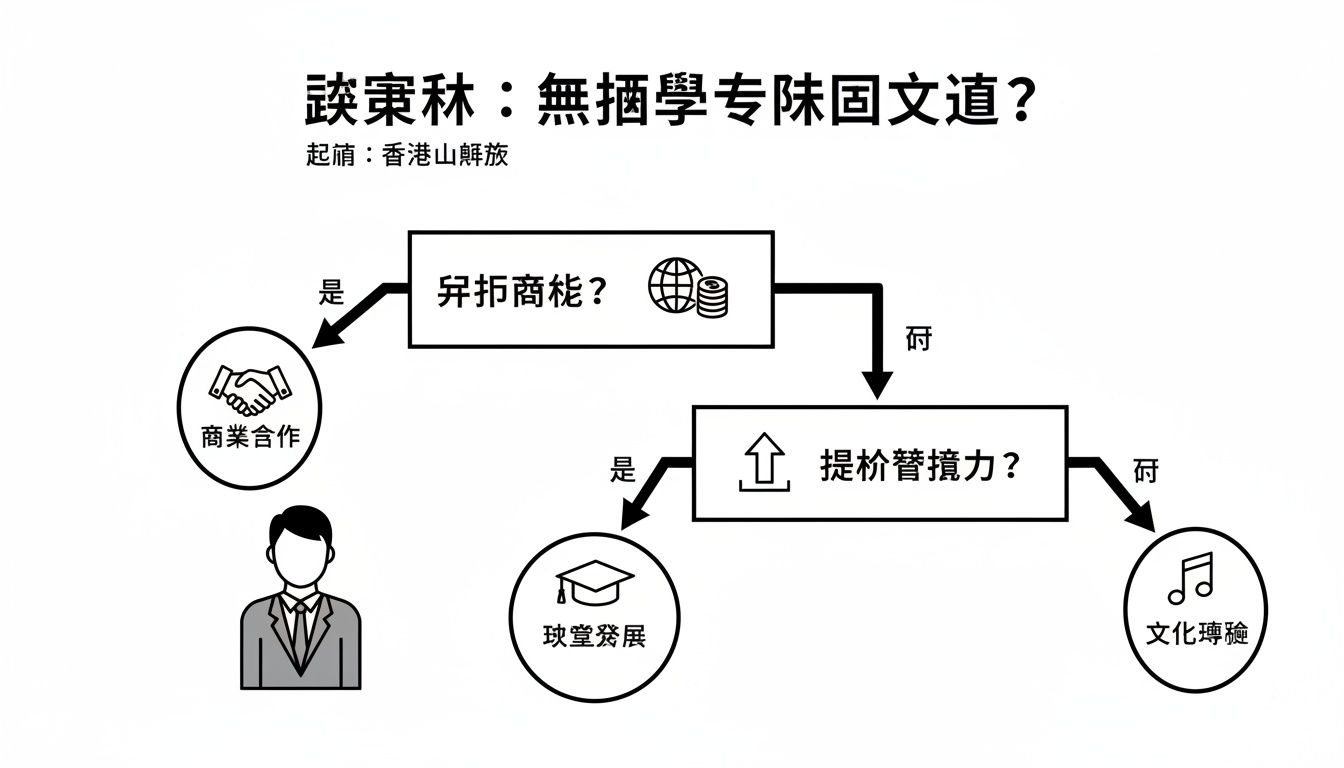
As can be seen from the picture, whether you want to expand your business territory or simply want to improve your personal competitiveness, learning Spanish is a strategic investment with a clear goal.
Comprehensive Analysis of Course Models
To gain a deeper understanding of the differences between different courses, we can compare them from the perspectives of learning pace, interactivity, tuition fees, and time flexibility.
Small class teaching (maximum 6 people) * Suitable for those who like interactive learning, want teachers to take care of them, and want to have classmates to practice with. Whether you are a beginner or have some foundation, this is a popular choice to balance learning effect and cost. * Advantages: Ensure that every student has enough opportunities to speak and ask questions, and at the same time have a learning atmosphere of mutual encouragement. Like the Spanish Cultural Association of Hong Kong , they insist on a maximum of 6 students in a class to ensure teaching quality and interaction. * Disadvantages: Class time is relatively fixed, so you have to follow the progress of the class.
One-on-one private lessons are most suitable for those who have clear goals (such as taking the DELE exam, preparing to go to Spain to do business), or who have an uncertain time to rework, or even want to strengthen training based on their own weaknesses. * Advantages: The course content and pace are completely tailor-made for you , with the highest time flexibility and naturally the highest learning efficiency. * Disadvantages: The tuition is the most expensive among the various modes, and there is no opportunity to communicate with other students.
When choosing a course, don't just look for the so-called "best" model. Instead, look for the one that is "most suitable" for you. Think about your personality, budget and pace of life, so you can first find a learning path that you can stick to.
Courses from large chain institutions are most suitable for those who like systematic and structured courses and want to choose a big brand with many branches and a good reputation. * Advantages: The course structure is very complete and the levels are clearly divided. There are usually branches in different districts, making it very convenient to return to school. * Disadvantages: The class size may be larger, and the teacher may not be able to take care of each student one by one. The interactivity is naturally not as good as in small classes.
Online distance courses are most suitable for those who live far away, travel all day long, or who like to study at home in their spare time. * Advantages: Save a lot of travel time, the class location is very flexible, and the online course options are more diverse. * Disadvantages: It tests your self-discipline and always lacks the feeling of real face-to-face interaction.
Comparison of Spanish language course formats for adults in Hong Kong
In order to help you make a more intuitive comparison, we will show you the entire table below, showing you the advantages and disadvantages of different modes and their suitable candidates at once.
Course Mode | Suitable partners | advantage | shortcoming | Reference fee |
|---|---|---|---|---|
Small class teaching | Learners who enjoy interaction and seek value for money | Good atmosphere, lots of interaction, and sufficient teacher attention. | The time is fixed and needs to be coordinated with the class schedule. | medium |
one-on-one private | Learners with specific goals and flexible schedules | Fully customized, highly flexible in terms of time, and extremely efficient. | Highest cost, lack of interaction with classmates | Highest |
large institutions | Learners who prefer systematic learning and convenient locations | The curriculum is well-structured and has a wide network of branch schools. | Large class size, low individual attention | Medium to High |
Online courses | Learners with high flexibility and self-discipline are needed. | Convenient, time-saving, flexible location, and many choices | Lack of real interaction, tests self-discipline | Lower to medium |
After looking at the watch, is the microphone much clearer? Each model has its own unique value. The most important thing is to understand your own needs so that you can make the most informed decision.
How to choose a good Spanish literature school
If you want to learn adult Spanish well , choosing a school is definitely the first critical step, and it can even be said to be half the battle. There are so many choices in Hong Kong. How can you avoid the traps and find a good school that is truly suitable for you? In fact, it is not complicated. As long as you know a few key points, you can easily select the most ideal study partner.

Evaluating teacher quality and teaching methods
When choosing a school, the most important thing is the teacher. A good teacher is not just someone who can speak Spanish, but more importantly, someone who knows how to "teach".
Native language teachers are essential: to learn the most authentic pronunciation, intonation, and cultural essence, native language teachers are indispensable.
Teaching certification is even more crucial: Do teachers hold relevant education degrees or professional teaching qualifications? This indicates that they have received formal training and know how to design courses tailored to the needs of adult learners. To understand what high-quality teachers look like, you can refer to the backgrounds of over 30 professional mother tongue teachers at the Hong Kong Spanish Cultural Association .
Teaching methods should be interactive: Adults hate dull and rigid learning. A good school will use interactive teaching methods, such as role-playing and group discussions, to encourage you to speak up more naturally and apply what you learn in a relaxed atmosphere.
Examine the curriculum structure and learning environment
Besides the teacher, the course design and the classroom environment also have a profound impact.
It's worth noting that Hong Kong people already have a strong foundation in languages. According to the 2021 census, 65.2% of those aged 6 to 24 enrolled in full-time courses were proficient in two languages and three languages, laying a solid foundation for learning new languages such as Spanish in the future. If interested, you can refer to the Census and Statistics Department's report to learn more about language use in Hong Kong.
Considering the school location and student reputation
Location convenience often determines whether you can stick to it. Choosing a school close to your company or residence can greatly reduce the likelihood of missing classes due to commuting difficulties. For example, the Hong Kong Spanish Cultural Association has centers in Tsim Sha Tsui and Causeway Bay , which are very conveniently located.
Before choosing a school, be sure to make good use of "free trial classes" or "level assessments". Experiencing the teacher's teaching style, classroom atmosphere and environment firsthand is the most direct and effective assessment method, better than a thousand words.
The final and crucial step: check the school's reputation. Search online for reviews from other students, or ask friends who have studied Spanish. Authentic feedback is often more valuable than any fancy advertisement. A school with a good reputation proves its teaching quality has stood the test of time.
By combining the above factors—faculty, teaching methods, curriculum, location, and reputation—you can establish your own evaluation criteria, systematically compare different schools, and ultimately find the most suitable study partner for you.
Overcoming common barriers to learning Spanish for adults
For many office workers in Hong Kong, getting back their schoolbags is both exciting and challenging. Busy reworking, memory seems not as good as before, and fear of making mistakes. These are the most real psychological barriers when learning Spanish as an adult . But don’t be alarmed, these obstacles are not insurmountable walls. As long as you use the right methods, the learning process can inject new impetus into your life.

Adjust your mindset and embrace imperfection.
When adults learn, their biggest enemy is often themselves. We always want to get it right in one step, but we are surprised when we make mistakes in front of others, and we worry about not being able to keep up with the progress. This kind of "progress anxiety" and obsession with perfection will actually kill the fun and motivation of learning.
Learning a language is like learning to ride a bicycle, you must go through stages of stumbling. Instead of being surprised when you make a mistake, treat every mistake as a learning opportunity. Remember, your goal is to communicate effectively, not to be a perfect grammarian.
It is important to establish a positive attitude. You can try the following methods:
Set "small but beautiful" goals: Don't think about speaking fluently from the beginning. It’s better to start with “Learning to order a cup of coffee in Spanish” or “Understanding a lyric”. Every time you achieve a small goal, the sense of accomplishment is so real.
Focus on the process, not the results: Enjoy the fun of learning new knowledge, don’t just look at a certificate or a grade.
Make good use of spare moments and integrate learning into your life.
"I'm too busy reworking, do I have time to study?" This is the most common excuse, but it is actually the easiest problem to solve. Successful adult learners are masters of time management and know how to "seamlessly integrate" Spanish into their daily lives.
Try these efficient time management techniques:
Turn your commute into a classroom: Listen to a Spanish podcast or audiobook while taking the subway or bus to help your ears get used to the rhythm of the new language.
Set a "15-minute study alarm": fix a time every day, for example, after eating, study for 15 minutes. The cumulative effect over time is far beyond your imagination.
Change your entertainment habits: When watching Netflix, change the subtitles to Spanish, or listen to Spanish pop music to turn learning into a relaxing and interesting thing.
Overcome memory challenges and say goodbye to rote memorization.
Many people feel that after getting older, their memory is not as good as before, and memorizing new words becomes a chore. In fact, it's just because you haven't found your own memory method. Instead of memorizing by rote, try some smarter methods:
Association: Connect new words with familiar things or pictures. For example, when remembering "mesa" (台), you can imagine the funny scene of Messi playing waves on a stage.
Spaced Repetition: Use mobile apps like Anki or Quizlet. They will remind you to review the book at the right time based on your forgetting curve, which is extremely efficient.
Create a safe language practice environment
Having no practice subjects is a major pain point for Hong Kong learners. Even if you have learned a lot, it will be in vain if you dare not speak. Therefore, it is very important to choose a learning environment that encourages interaction.
For example, in a small class teaching environment like the Hong Kong Hispanic Cultural Association , teachers will create a safe and pressure-free speaking space through role-playing and topic discussions. You can practice together with classmates of similar skill levels at centers in Tsim Sha Tsui or Causeway Bay and encourage each other. Because everyone is eager to learn, they can naturally put down their burdens and be brave enough to use what they have learned. This is of great help in building self-confidence in speaking.
Plan your learning journey: CEFR and international exams
The biggest fear in learning adult Spanish well is standing still, not knowing how much progress you've made or what your next step should be. The best way to get rid of this confusion is to create a clear learning roadmap for yourself.
The two pillars of this map are the internationally recognized Common European Language Reference Standards (CEFR) and your personal goals—such as obtaining international certifications like DELE or SIELE.
Level Up! Learn about the CEFR language proficiency levels
You can think of CEFR as a leveling system in a video game. It divides language skills into six levels from basic to advanced: A1, A2, B1, B2, C1, and C2. Each level has clear ability indicators, allowing you to know exactly which level of "skill" you have mastered.
A1 (Beginner Level): You can give a simple self-introduction, greet others, and ask some background-checking questions. Just like in a restaurant in Barcelona, you can confidently order by saying "Quiero un café, por favor" (I'd like a coffee, thank you).
A2 (Basic Level): You can understand and apply topics most closely related to your life, such as family, shopping, and work. When traveling in Spain, you will have no problem asking for directions to the Sagrada Familia and can understand basic instructions given by locals.
B1 (Advanced): Congratulations! You can now handle most situations you might encounter in Spanish-speaking regions and can easily share your experiences, dreams, and plans. This means you can now chat with newly acquainted Spanish friends about the fun things that happened on your last trip.
B2 (Advanced): At this level, you can chat fluently and naturally with native speakers, understand the gist of complex articles, and even express your own views on different topics. In the workplace, you can easily hold meetings and discussions in Spanish.
The CEFR is more than just an assessment standard; it's like a mirror, honestly reflecting your overall abilities in listening, speaking, reading, and writing. With it, you can set more realistic learning goals and take each step more steadily.
Get a certificate to prove your ability: DELE vs SIELE
Once your Spanish reaches a certain level, an internationally recognized certificate can significantly boost your chances of admission to higher education, immigration, or job hunting. In Hong Kong, the two most common exams are DELE and SIELE.
DELE (Diplomas de Español como Lengua Extranjera)
Features: Issued by the Cervantes Institute, an official Spanish institution, it is valid for life and is the most widely recognized Spanish proficiency certificate in the world. The exam is divided into six independent levels from A1 to C2; you need to apply for the corresponding level based on your proficiency.
Who is this suitable for: You who have a very clear goal and need a "permanent" language proficiency certificate.
SIELE (Servicio Internacional de Evaluación de la Lengua Española)
Features: Also certified by authoritative institutions such as the Cervantes Institute, but with a more flexible format. It uses a scoring system (out of 1000 points), allowing you to assess your overall level under the CEFR standard with a single exam. The results are valid for five years , are taken entirely on a computer, and are available faster.
Who is this suitable for: learners who want to get results quickly or who want to fully assess their current abilities.
Regardless of which exam you choose, thorough preparation is key to success. For example, the Hong Kong Spanish Cultural Association offers comprehensive preparation courses covering DELE, SIELE, IGCSE, IB, and HKDSE, providing intensive training in writing, speaking, and listening/reading strategies to help students systematically improve their test-taking abilities. You can learn more from student testimonials and see how the courses align with their academic and career goals .
With a clear roadmap and professional guidance, your adult Spanish literature learning journey will naturally be smoother and more efficient.
Frequently Asked Questions (FAQ)
I have no basic knowledge and am afraid of being ugly. How about small class teaching for me?
Absolutely, you can even say that small class teaching is just for you! Like professional language schools like the Hong Kong Spanish Cultural Association , their entry-level A1 level is specially designed for students with no basic knowledge. The course will start with the most basic letter pronunciation and greetings, taking you step by step. The small class atmosphere of up to 6 people is relaxed, the teacher can take care of everyone, and the students in the class are all about the same level. Starting from scratch together, everyone will build up the confidence to speak Spanish faster.
You have to do OT all day long, and the time is so unstable. How do you keep studying?
Choosing a school with flexible plans is key. For example, the Spanish Cultural Association of Hong Kong has physical centers in Tsim Sha Tsui and Causeway Bay, as well as online courses, so you can easily adjust classes or switch to online classes according to the situation. If work hours are extremely erratic, one-on-one private lessons are the most flexible option. In addition, you must learn to make good use of the "fragmented time" when taking a ride or eating out, use mobile apps or listen to podcasts to review books, and integrate learning into your life.
How long do you need to learn before you can even communicate the basics while traveling?
Generally speaking, when you complete the A1 level of the Common European Framework of Reference for Languages (CEFR), it will take about 70 to 80 hours of classroom study. By then you will be able to handle the most basic communications such as ordering food at a restaurant, asking for transportation directions, and checking in at a hotel. If you insist on attending class every week, most students can reach this level in about 6 to 9 months.
How much does it cost to learn Spanish in Hong Kong? Will it be expensive?
Tuition fees are generous and frugal. Private tutoring costs about HK$400 to HK$800 per hour, with the highest cost. For organizations like the Spanish Cultural Association of Hong Kong that focus on Spanish teaching, the monthly tuition for small class courses is usually a few thousand dollars. In addition to the fact that it is worth it every hour, the CP value is relatively the highest. Before making a decision, it is strongly recommended that you take a free trial class or level assessment to ensure that you get value for money.
Is it necessary to take the DELE exam? Will it be difficult?
DELE is the most authoritative official Spanish exam in the world. It is somewhat challenging, but it is definitely not out of reach as long as you are well prepared. You have to take the exam, it all depends on your personal goals. If you plan to study, work or immigrate to Spain or Latin America, a DELE certificate is usually required. If it is purely for fun or travel, there is no need to take the exam in a hurry. If you decide to take the exam, enrolling in preparation courses such as the DELE exam preparation class of the Hong Kong Hispanic Cultural Association will get twice the result with half the effort.
Which is better, small group classes or private tutoring?
If you like an interactive atmosphere, want to practice with classmates, and have a limited budget, small class teaching is a cost-effective option. If you have specific goals (such as preparing for exams or business negotiations), have variable rework time, or want to improve quickly on your weaknesses, this fully customized one-on-one private tutoring course is more suitable for you.
Is it really important to have a native speaker teacher?
Absolutely important. By studying with a native-speaking teacher, you can not only learn the most authentic and natural pronunciation and intonation, but also gain an in-depth understanding of the cultural meaning and daily usage behind the words, which are difficult to fully impart to non-native-speaking teachers.
In addition to attending class, are there any ways to speed up progress?
There is no better way to incorporate Spanish into your life than to integrate it into your life. You can try: watching Netflix Spanish dramas (such as "Paper House"), listening to Spanish songs, setting the language of your mobile phone to Spanish, and following Spanish news or KOLs. The more exposure you have, the faster you will naturally progress.
Are you ready to start your Spanish journey? No matter what your goals are, the Spanish Cultural Association of Hong Kong can provide you with the most professional guidance and the most suitable courses. Contact us via WhatsApp now to make an appointment for a free level assessment or trial, and we will help you take the first step to success!