
Comparing Spanish and French: Which one is more suitable for Hong Kong people to learn?

For those looking to learn another foreign language in Hong Kong, Spanish and French are popular choices. Simply put, Spanish has straightforward pronunciation, a large global audience , and is easier to learn, making it suitable for those who want to quickly learn to communicate while traveling or explore emerging markets. French, on the other hand, appeals to its rich cultural heritage and its place in traditional international organizations . If you have a passion for European culture, art, or diplomacy, French might be for you.
Target audience of this article
Students and parents planning their children's further education: They are choosing a second foreign language for HKDSE, IB or IGCSE and want to know which language has a greater strategic advantage.
Adults seeking career breakthroughs: They want to learn a new language to enhance their competitiveness in the workplace, especially in the international trade, finance, or retail industries.
Language learning enthusiast: Interested in Romance languages, comparing the learning difficulty and cultural appeal of Spanish and French.
Key Summary
Pronunciation difficulty: Spanish pronunciation rules are straightforward (what you see is what you get), making it more friendly to Hong Kong people; French has complex nasal and liaison rules.
Global applicability: Spanish is the official language of more than 20 countries, covering a vast emerging market in Latin America; French remains influential in diplomacy and certain traditional areas.
Study abroad strategy: In the HKDSE, there is less competition for Spanish, and the chances of winning are relatively higher, which is a strategic advantage.
Local resources: Hong Kong already has a mature Spanish language learning ecosystem. For example, the Hong Kong Spanish Cultural Association provides mother tongue teachers and small-class teaching, which greatly improves learning efficiency.
Interested in learning Spanish? The Hong Kong Spanish Cultural Association offers small group classes taught by native Spanish speakers to help you get started easily. Feel free to WhatsApp us anytime to book a free trial class or a professional assessment!
Spanish vs. French: Quick Comparison
Torn between Spanish and French? The most pressing questions are which is easier to learn and which is more practical. Both languages originate from Latin and share many similarities with English, but their pronunciation, grammar, and global applicability differ significantly, directly impacting your learning experience and future rewards.
Let's start with pronunciation. For Hong Kong people, the Spanish pronunciation system is a godsend. Its vowels are very stable; you pronounce it exactly as you spell it, with almost none of the complex nasal sounds, liaisons, and numerous silent letters found in French. This means you can quickly read with confidence, easily overcoming the biggest hurdle in the early stages of learning.
Let's look at practicality. More than 500 million people worldwide speak Spanish as their native language, and it's an official language in as many as 20 countries , particularly across Latin America—a huge emerging market. In contrast, while French remains important in Europe, parts of Africa, and international diplomatic settings, it lags behind the Spanish-speaking world in both the number of native speakers and the growth potential of the economies involved.
If you want to get started quickly and apply the language in business or explore multiculturalism, Spanish is often a more efficient choice. Its straightforward pronunciation rules and wide geographical coverage mean a gentler learning curve and broader application scenarios.
Below, we'll quickly outline the key differences between Spanish and French from five core dimensions to help you find your way quickly.
A quick overview of the core differences between Spanish and French
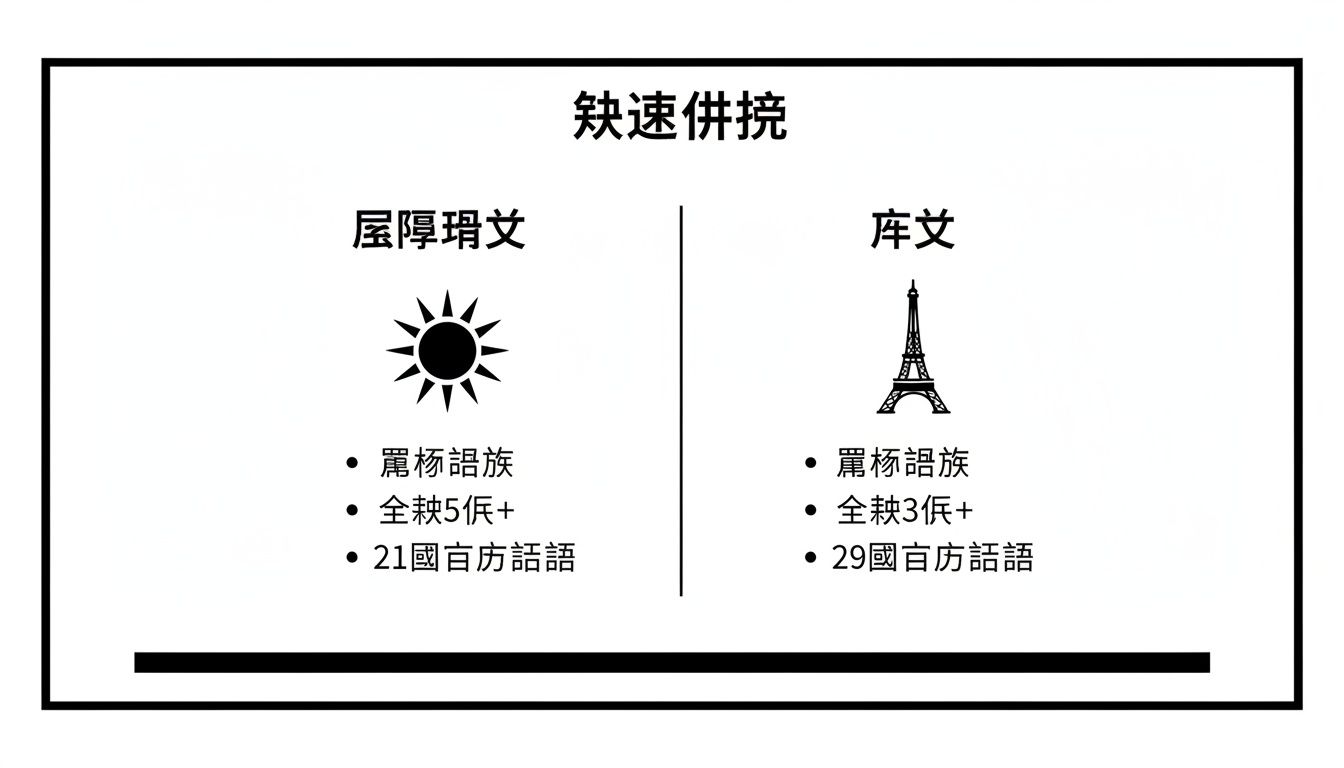
This table quickly compares Spanish and French across five key dimensions, helping you to initially determine which language better suits your learning goals.
Comparison Dimensions | Spanish (Español) | French |
|---|---|---|
Pronunciation difficulty | Lower, spelling and pronunciation are highly consistent. | Higher pitch, with nasal sounds, liaisons, and unpronounced letters. |
Global users | More than 590 million people (native language + second language) | Approximately 300 million people (native language + second language) |
Syntactic complexity | Verb conjugation is relatively regular, with many tenses. | There are many irregularities in verb conjugation, and the grammar is strict. |
Learning curve | The initial period is relatively smooth, making it easier to build confidence. | The initial sections are quite steep, posing a significant challenge to pronunciation and hearing. |
Cultural influence | Latin American culture, music, and film | European art, fashion, food, and philosophy |
Simply put, Spanish is superior in terms of ease of learning and global applicability, while French has a stronger influence on traditional culture.
Practical considerations in Hong Kong
Back in Hong Kong, the choice of language also involves different considerations. Traditionally, French is more prevalent in local secondary and university curricula. However, the trend of learning Spanish has been growing rapidly in recent years, especially in public examinations such as the IB and HKDSE , where students who choose Spanish often have a strategic advantage due to fewer competitors.
From a career perspective, Hong Kong, as an international trade and financial hub, is increasingly intertwined with Latin American markets. Proficiency in Spanish not only helps in opening up new markets but has also become a sought-after skill for many multinational corporations (such as Zara and Mango ). If you would like to delve deeper into the practicalities, pronunciation, and spelling of these two languages, you can read our reflections on Spanish and French usage .
Ultimately, your choice should be based on your personal interests, learning style, and long-term goals. If you want to quickly master a practical communication tool and explore the vast Latin American culture and business opportunities, then Spanish is undoubtedly the ideal choice.
Pronunciation vs. Grammar: Which language is easier to learn?
When deciding to learn a new language, "ease of learning" is almost always the first question in the minds of Hong Kong people. Spanish and French both originate from Latin and belong to the Romance language family, sharing many similarities. However, their learning curves are quite different when it comes to pronunciation and grammar, the two first hurdles for beginners. Frankly speaking, if we only consider the introductory stage, Spanish is indeed much more approachable than French.
The biggest advantage of Spanish is its highly standardized spelling rules . Simply put, it's "what you see is what you get." Its vowel system is very crisp, with only five basic vowels (a, e, i, o, u), and the pronunciation is clear and fixed, unlike the unpredictable sounds of English.
What does this mean? As long as you spend the time memorizing the pronunciation of the alphabet, you can basically read most Spanish words accurately. This direct feedback allows beginners to build confidence in reading aloud in a very short time, greatly reducing the initial sense of frustration.
In contrast, the French pronunciation system is much more complex and is definitely a big challenge for beginners.
The initial challenges of French pronunciation
French pronunciation rules are quite complex, and there are several points that Hong Kong learners will inevitably encounter as initial hurdles:
Nasal vowels : These nasal sounds, such as "on," "en," "an," and "in," are rare in both Cantonese and English. You need specific training to master the use of oral and nasal muscles and accurately imitate them.
Silent Letters : French words often contain silent "hidden" letters at the end. For example, the final "p" in "beaucoup" (many) or the final "ent" in "parlent" (they say) are silent. This makes it impossible to guess the pronunciation by spelling alone.
Liaison and Enchaînement : When a word ends in a consonant and the next word begins with a vowel, they are often pronounced together. For example, in "les amis" (friends), the "s" is pronounced as /z/. This rule undoubtedly increases the difficulty of listening comprehension and spoken fluency.
The pronunciation of various letter combinations is varied : for example, “eau” is pronounced /o/, “oi” is pronounced /wa/, and “ou” is pronounced /u/. These require a lot of time to memorize and practice.
These complex rules mean that French learners must invest more effort in building a solid foundation in pronunciation in the early stages, otherwise they are likely to develop accents that are difficult to correct.
A comparison of the depth of grammatical structures
At the grammatical level, the complexities of the two languages begin to emerge. However, overall, Spanish rules are relatively clearer, and there are fewer irregularities.
A classic example is the usage of the verb "to be". French has only one verb , "être" , which is similar in usage to the English "to be". However, Spanish has two verbs , "ser" and "estar" , to express the concept of "to be", which is a unique challenge for beginners.
"Ser" is used to describe permanent, essential characteristics (such as nationality, occupation, or personality), while "estar" is used to describe temporary states or locations (such as emotions or geographical locations). Although this may cause some confusion at first, once you grasp the core logic behind it, you can express the meaning more accurately.
Another important point of comparison is verb conjugation. While both languages have a large number of verb conjugations to memorize, Spanish is significantly more regular. Most verbs follow the rules of the three endings (-ar, -er, -ir), and there are fewer irregular verbs in Spanish than in French. French has a large number of irregular verbs, and the conjugation patterns are more fragmented, requiring more time to master them one by one.
In terms of tense, both have rich tense systems, including the dreaded subjunctive mood. However, it is generally believed that the usage rules of the Spanish subjunctive mood are more systematic than those of the French, and its triggering conditions are easier to grasp.
To gain a deeper understanding of the specific difficulties that Hong Kong people may encounter when learning Spanish and how to overcome them, you can refer to our complete analysis of the Spanish learning blueprint , which contains a more detailed analysis.
In summary, from the intuitiveness of pronunciation to the clarity of grammatical rules, Spanish offers a gentler entry point for beginners. This is not to say that French cannot be learned well, but rather to remind learners that they need to be mentally prepared to invest more time and patience in the early stages of learning to overcome the challenges of pronunciation and grammar.
Vocabulary Relationships and Local Learning Resources in Hong Kong
When it comes to learning Spanish and French, many people will first look at vocabulary. Indeed, since both are derived from Latin and have a large number of "relative words" (cognates) with English, this is a very friendly starting point for Hong Kong people with a good command of English.
Just like "information" in English, it is "información" in Spanish and "information" in French; another example is "nation", which corresponds to "nación" in Spanish and "nation" in French. This familiarity with vocabulary can help you get started quickly in the early stages and build confidence.
However, choosing based on vocabulary similarity alone is actually too superficial. A more realistic and critical factor is: In Hong Kong, which language learning resources are more in place? How much support you can find locally is often the first factor that determines whether you can succeed in your studies.
The Evolution of Hong Kong's Learning Ecosystem
Traditionally, French has been relatively "inclusive" in Hong Kong's education system. Many schools offer French classes as a second foreign language, and the resources are naturally mature. But in recent years, the situation has been very different. The craze for learning Spanish has swept across Hong Kong, and many high-quality learning centers and courses have emerged.
Behind this change is actually the market's recognition of the practical value of Spanish - whether it is business, tourism or cultural exchanges, the importance of Spanish is becoming more and more prominent. For this reason, more and more professional courses are being opened specifically for practical conversation and international examinations (such as DELE, IB, IGCSE ), providing learners with more diverse choices and clearer goals.
For Hong Kong learners, the problem is no longer whether the language itself is difficult, but whether there are more efficient and closer to your goals in learning the language. A good learning environment can break down theoretical difficulties into step-by-step practical exercises.
Compared with self-study or large-scale tutoring centers, a language center with a complete teaching model and excellent teachers can definitely save you a lot of mistakes. In Hong Kong, more and more people are discovering that small class teaching and an immersive environment created by native-speaking teachers are the fastest way to break through learning barriers.
How can high-quality local resources help you "speed up" your process?
Take the Spanish Cultural Association of Hong Kong as an example. Their teaching model reflects the importance of high-quality local resources. The association insists on small class teaching with a maximum of 6 students to ensure that each student receives sufficient attention from the teacher and has plenty of opportunities to speak in class.
All courses are taught by more than 30 professional native Spanish-speaking teachers . Not only do they have rich teaching experience, but more importantly, they will bring authentic culture into the classroom, so that what you learn is no longer rigid grammar, but living communication.
The number of study hours and progress are the indicators that Hong Kong people are most concerned about. According to an analysis of a local study guide, it generally takes 500 to 600 hours to teach yourself Spanish to be able to handle daily conversations. But in immersive teaching centers like the Hong Kong Spanish Cultural Association, students can greatly shorten this time. Compared with French, the grammatical structure of Spanish is more straightforward. Even the intermediate courses of HKU SPACE only require 230 to 250 hours to consolidate the basics, which proves its advantage as an introduction to Romance languages. Want to know how to choose your own Spanish course? You can refer to our complete guide to learning Spanish in Hong Kong .
In addition, the association has teaching centers in Tsim Sha Tsui and Causeway Bay , which are conveniently located. Whether you are a student or a wage earner, it is easy to arrange time to attend classes. This convenience, coupled with the systematic courses ranging from children's enlightenment classes to adult DELE preparation classes, truly provides the most personalized support for learners with different needs.
To sum up, when comparing Spanish and French, in addition to the characteristics of the language itself, we should also pay attention to the local learning facilities in Hong Kong. An organization like the Spanish Cultural Association of Hong Kong that provides professional teachers, small class teaching and convenient school buildings is the key to ensuring that you get the maximum return on your investment of time and money.
Analysis of IB and DSE University Admission Pathways

For parents and students in Hong Kong, choosing a second foreign language (second foreign language) is not just a matter of cultivating interests, it is also a strategic investment related to the prospects of further education. Whether dealing with local DSE or international courses such as IB or IGCSE, Spanish and French have different strategic values. But when you deeply analyze past test data, you will find that choosing Spanish may open up an unexpected "blue ocean track" for you on your way to higher education.
Strategic Advantages of HKDSE Candidates
Under the DSE system, scores in Category C (other languages) subjects can be directly counted as one of the subjects in the Joint University Entrance Examination (JUPAS), which is absolutely crucial for students aiming for top-tier subjects. However, competition for mainstream foreign languages like Japanese is already fierce, while Spanish and French offer an easier path to success.
According to the Hong Kong Examinations and Assessment Authority's 2024 registration statistics, the total number of applicants for Spanish was 32 , while that for French was 36 , a similar number. However, it is worth noting that the number of applicants for Spanish has been growing quite rapidly in recent years, reflecting its increasing popularity.
Looking at the 2023 results, the advantage of Spanish becomes even more apparent: among the 19 candidates, a passing rate of 78.9% achieved level 3 or above, and 21.1% achieved the highest level of 5** or above. These figures strongly demonstrate that studying Spanish not only brings less competitive pressure but also offers the opportunity to achieve top marks, adding a significant advantage to your academic resume. For more detailed data from the Examinations and Assessment Authority, please refer to the official press releases issued by the Authority .
In the JUPAS score conversion, a 5** in a foreign language can have a greater impact than a 5* achieved through several times the effort in core subjects. Choosing Spanish is, to some extent, equivalent to choosing a shortcut to higher education with a higher return.
IB and IGCSE: A Global Perspective
In the IB (International Baccalaureate) and IGCSE curriculum systems, a foreign language is a compulsory core component. French, with its traditional academic standing in Europe, has always been a popular choice for international schools. However, Spanish's global applicability and ease of learning are making it a wiser choice for an increasing number of students.
The IB curriculum places great emphasis on cultivating students' international mindset, and Spanish, as the official language of more than 20 countries around the world, has a cultural reach spanning Europe and the whole of Latin America, perfectly aligning with the IB educational philosophy.
IB Spanish (Language B) : This course not only requires students to master the language, but also to gain a deep understanding of the culture, social issues, and literary works of the Spanish-speaking world. Because of the direct pronunciation, students can more quickly shift their focus from figuring out the sounds to higher-level analysis and expression.
IGCSE Spanish : As a bridging course to IB, IGCSE emphasizes building a solid language foundation. Spanish grammar is highly structured, which helps students perform more consistently in exams and paves the way for future IBDP studies.
In contrast, the complex pronunciation and grammatical rules of French can indeed make some students feel overwhelmed in the early stages, which in turn affects their interest in learning and their final grades.
Professional preparation is key to achieving high scores.
Regardless of the chosen path to higher education, relying solely on school curriculum to stand out in public examinations is extremely difficult; professional test-taking training is essential. Especially in the highly weighted oral and written sections, a student's performance and depth of expression are crucial in determining their chances of success.
For example, the Hong Kong Spanish Cultural Association offers preparation courses specifically for HKDSE, IB, and IGCSE candidates. These courses are taught by experienced native language teachers who are familiar with the exam format and grading standards, and can provide precise intensive training targeting the common mistakes and weaknesses of Hong Kong students.
In the association's small-class teaching environment, students have ample opportunities for one-on-one oral practice with teachers, simulating real exam scenarios to improve their test-taking skills and fluency. Teachers provide immediate correction of pronunciation and grammar errors and guide students in using more authentic and advanced vocabulary and sentence structures. In writing, teachers systematically teach writing techniques for different genres, from topic analysis and structure to argumentation, helping students build clear writing logic and avoid the pitfalls of Chinglish. This targeted guidance is the key to helping students transform language knowledge into high scores.
In conclusion, choosing Spanish is undoubtedly a smart strategy in the competition for higher education. Its lower entry barrier, higher chance of success, and the well-developed professional preparation resources in Hong Kong provide a clear and visible path to success for students pursuing top universities.
Career Development and Global Applicability
Choosing a foreign language is not only about interest and further education, but also a long-term investment in your future career. In the globalized world, "comparing Spanish with French" is no longer just a cultural choice; it's more like a business decision that affects your future opportunities and returns.
Frankly speaking, from market potential and industry applications to global influence, Spanish is showing an unstoppable growth momentum.
Spanish: The key to unlocking emerging markets
The value of Spanish extends far beyond Spain itself. More than 500 million people worldwide speak it as their native language, and more importantly, it is the lingua franca of emerging markets throughout Latin America. A report by Instituto Cervantes points out that Spanish is not only the world's second most spoken language, but its economic significance is also considerable.
For Hong Kong, an international financial and trade hub, Latin America is undoubtedly a new blue ocean full of opportunities. Whether you are involved in financial investment, international trade, or supply chain management, being proficient in Spanish means you can bypass translators and communicate directly with key figures in this vast market, building more stable business relationships.
In Hong Kong, which industries particularly require Spanish language skills?
The practicality of Spanish is particularly evident in several of Hong Kong's core pillar industries:
Fashion and Retail : Zara, Mango, Massimo Dutti… These well-known international brands all originate from Spain. If you understand Spanish, you will naturally have a unique advantage over others in purchasing, design communication, and brand management positions.
Tourism and Hospitality Industry : In recent years, more and more tourists from Spanish-speaking countries have visited Hong Kong, while Hong Kong residents are also keen to explore unique destinations such as South America. Naturally, employees who can provide Spanish-speaking services have become highly sought after.
Finance and Banking : As a bridge between East and West, Hong Kong routinely handles business with Latin American clients. In this context, fluent Spanish is key to breaking down barriers and building trust.
There's a very real situation in the workplace: when two candidates have similar qualifications, the one who knows Spanish is often seen as a key talent who can open up new markets for the company and is more likely to stand out.
French: An elegant calling card in traditional fields
In contrast, French's strengths are more concentrated in traditional and specific areas. It still maintains a considerable position in diplomacy, international organizations (such as the United Nations and the European Union), the luxury goods industry (fashion, wine, and cosmetics), and some African markets.
If your career plans involve a career in diplomacy, academic research, or working for top luxury groups like LVMH or Kering, then French is undoubtedly a highly prestigious and elegant calling card.
However, purely in terms of economic growth potential and market breadth, the economies covered by French are no longer comparable in vitality and scale to the vast Spanish-speaking world.
Business Evidence: The Commercial Value of Spanish
The commercial value of a language ultimately depends on market demand. The Hong Kong Spanish Cultural Association not only serves individual students, but also provides professional Spanish language training for many well-known companies—this is the best proof of market demand.
We have provided internal employee training for top companies such as FC Barcelona , renowned fashion brands Cortefiel , and Zara . These cases clearly demonstrate how international brands understand the importance of Spanish proficiency for improving team communication efficiency, strengthening corporate culture, and expanding global business. Working professionals can also systematically learn business communication skills through our adult Spanish courses, truly transforming language ability into workplace competitiveness.
So, how should we choose?
On the career path of "comparing Spanish and French," your choice should be based on your vision for the future:
Looking for broad business opportunities and emerging markets? If you're focused on international trade, finance, tourism, or the fast-moving consumer goods industry and hoping to capitalize on the economic growth of the next decade, Spanish could be a more lucrative option.
Focus on a specific traditional field? If you have a strong interest in diplomacy, art, luxury goods, or academic research, and plan to develop your career in Europe or a specific African country, then French still has its unique value.
In summary, French is like a language that unlocks specific, sophisticated fields, while Spanish is more like a master key that unlocks the world's most dynamic and emerging markets. For someone like you, based in Hong Kong with a global perspective, investing in Spanish is investing in a broader and more diverse future.
Frequently Asked Questions (FAQ)

1. If I have no knowledge of foreign languages, how easy is it to learn?
For beginners, especially Hong Kongers accustomed to Cantonese, Spanish is usually easier to learn . The key difference lies in pronunciation. Spanish pronunciation is very straightforward, almost "what you see is what you read." In contrast, French has many nasal sounds, liaison rules, and a large number of silent letters, which can be more frustrating for beginners.
2. If I want to study Spanish in DSE, will it be difficult to pursue it?
Absolutely not. Because the competition for DSE Spanish is relatively thin, and the test content has a fixed scope, as long as you follow the guidance of professional teachers and carry out targeted practice, it is actually easier to achieve good results than you think. At the Hong Kong Hispanic Cultural Association, we have exam preparation classes specially designed for HKDSE, IB and IGCSE candidates. They are taught by native teachers who are familiar with the exam pattern and can help you master the skills to reach for the stars.
3. I am an adult. What practical use is there for me after learning Spanish besides traveling?
Beyond travel, the value of Spanish in the workplace is increasingly recognized, especially in Hong Kong, an international hub. Many international brands (such as Zara and Mango) and financial institutions are actively expanding into the vast Latin American market. If you understand Spanish, your resume will naturally stand out , giving you the opportunity to become a key figure in your company's expansion into new markets. Enrolling in our adult Spanish courses can help you master business terminology and enhance your workplace competitiveness.
4. Do you want to choose small class teaching?
Small class sizes (e.g., a maximum of 6 students) ensure that each student receives sufficient attention from the teacher and has ample opportunity to practice speaking. This is especially important for language learning, as you can receive immediate corrections in pronunciation and grammar. At the Hong Kong Spanish Cultural Association, located in the heart of Tsim Sha Tsui and Causeway Bay, we are committed to small class sizes to create an immersive learning environment.
5. How long does it take to learn basic communication?
Learning progress varies from person to person, but the learning curve for Spanish is relatively gentle. Generally speaking, with our systematic curriculum and the guidance of native language teachers, most students, after completing the A1 level (approximately 60 hours), are able to handle basic daily conversations such as self-introduction, asking for directions, and ordering food. Compared to self-study, regular in-class attendance can significantly shorten learning time.
6. I want to help my child choose a second foreign language. At what age should they start learning?
Linguists generally agree that the golden age for language learning is between 3 and 6 years old . Children at this stage have the strongest ability to imitate sounds and can naturally master authentic pronunciation. Spanish has a lively tone, making it very suitable for teaching through games and nursery rhymes. Our children's Spanish curriculum uses this fun and engaging approach to help children fall in love with Spanish in a happy environment.
7. Should I take the DELE exam when learning Spanish?
The DELE certificate is the most authoritative international proof of Spanish language proficiency, issued by the Cervantes Institute in Spain, and is valid for life. Whether for further education, job hunting, or immigration, a DELE certificate will enhance your resume. We offer DELE preparation courses at all levels to help you prepare fully.
At the crossroads of "Spanish versus French," this article aims to provide clear guidance. Regardless of your final language choice, sustained passion and the right learning methods are key to success. If you are curious about Spanish and want to experience the interactive fun of small-group teaching, please contact the Hong Kong Spanish Cultural Association .
Our professional course consultants are happy to provide you with a free level assessment and course consultation to help you easily take your first steps in learning Spanish. Inquire now via WhatsApp and book your free trial class! https://spanish.hk